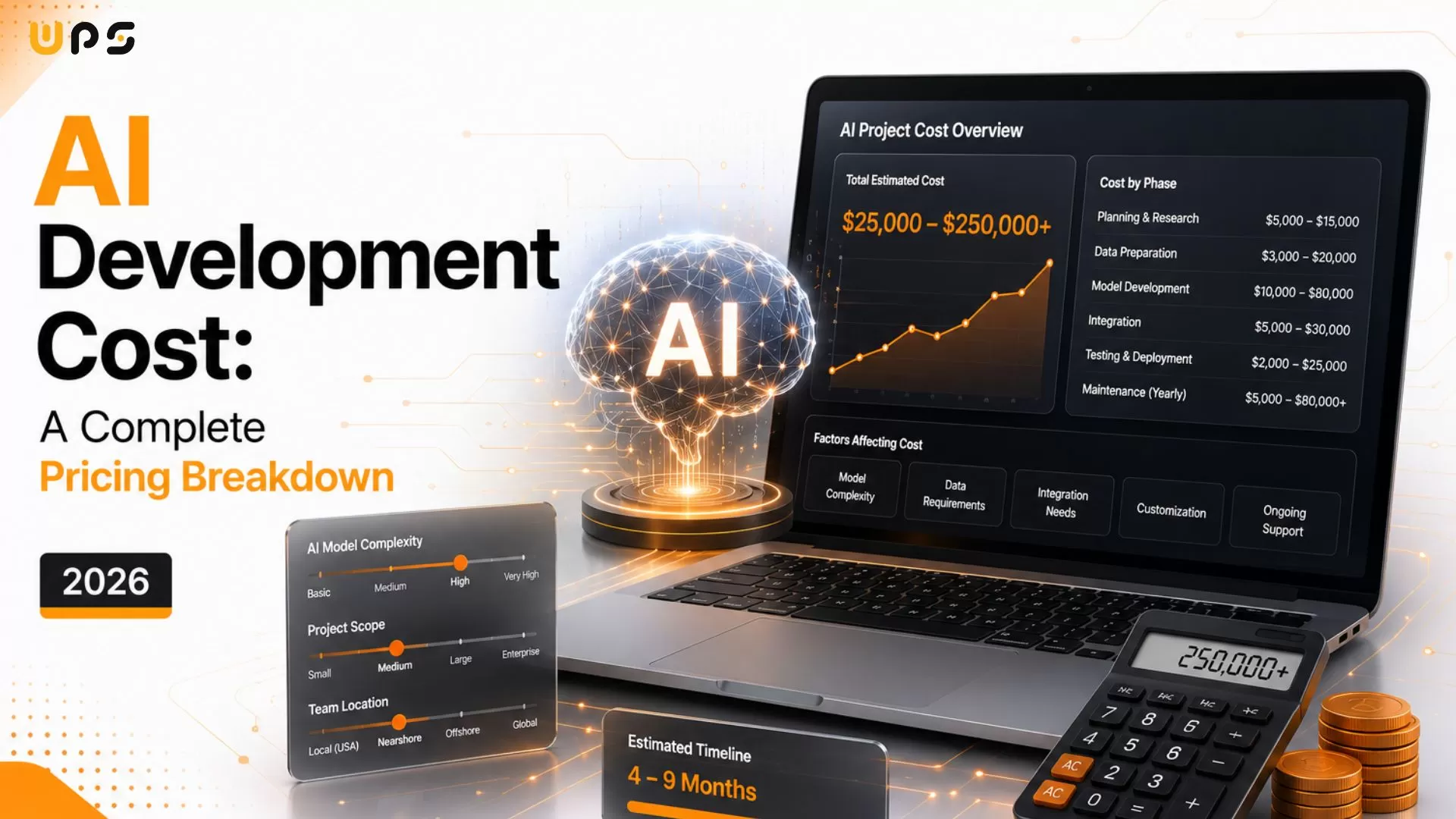
Artificial intelligence is no longer limited to large enterprises with multi-million-dollar technology budgets. Today, startups, mid-sized businesses, and global organizations are investing in intelligent software to automate operations, improve customer experiences, and gain a competitive advantage. However, before moving forward with any project, one question almost every decision-maker asks is: How much does AI development cost?
The answer depends on several factors. A simple AI-powered chatbot may require a modest investment, while a custom enterprise platform with advanced automation, multiple integrations, and proprietary models can cost significantly more. Project scope, development complexity, infrastructure, data requirements, security, and ongoing maintenance all play a role in determining the final budget.
Without a clear understanding of these variables, businesses often underestimate costs, delay project timelines, or invest in features that don't deliver meaningful value. A realistic budget starts with understanding where your investment goes and which factors have the biggest impact on development costs.
If you're comparing development partners, planning a new product, or estimating your project budget, having a clear understanding of development costs can save both time and money. The insights in this guide will help you evaluate pricing with greater confidence and prepare for every stage of the development process.
Key Takeaways
- AI development costs vary based on project scope, complexity, integrations, and business requirements.
- Building a custom solution typically costs more than using existing models or third-party APIs, but it also offers greater flexibility and scalability.
- Development expenses extend beyond coding and often include planning, data preparation, cloud infrastructure, testing, deployment, and ongoing maintenance.
- Understanding the cost drivers early helps businesses set realistic budgets and avoid unexpected expenses during development.
- Choosing an experienced development partner can improve project outcomes while keeping costs aligned with your business goals.
What Is AI Development?
AI development is the process of building software that can analyze information, recognize patterns, generate content, automate tasks, and support business decisions with minimal manual effort. Instead of relying solely on predefined rules, these systems use machine learning models, natural language processing (NLP), computer vision, and other technologies to perform tasks that traditionally required human intelligence.
Businesses across industries are using AI to solve real operational challenges rather than simply adopting new technology. From automating customer service and processing large volumes of documents to forecasting demand and detecting fraud, AI applications are becoming a practical investment for organizations looking to improve efficiency and reduce manual work.
Some of the most common AI development projects include:
- AI chatbots and virtual assistants
- AI agents for workflow automation
- Recommendation engines
- Predictive analytics solutions
- Computer vision applications
- Natural language processing (NLP) systems
- Intelligent document processing
- Speech and voice recognition software
- Custom enterprise AI applications
Although these solutions fall under the same category, they differ significantly in terms of development effort, infrastructure requirements, integrations, and ongoing maintenance. For example, an AI chatbot built using existing APIs can often be delivered within weeks, while a custom enterprise platform that integrates with multiple business systems and processes large datasets may take several months to develop.
This is one of the primary reasons AI development costs vary so widely. The overall investment depends on the type of solution you're building, the complexity of its features, the quality of available data, and the level of customization required to meet your business objectives.
Why Businesses Invest in AI Development
Organizations invest in AI development for different reasons, but the goal is usually the same: improve efficiency, reduce operational costs, and deliver better customer experiences.
Some of the most common business objectives include:
- Automating repetitive business processes
- Improving customer support with intelligent chatbots
- Generating data-driven insights for faster decision-making
- Personalizing customer experiences
- Reducing manual errors across business operations
- Increasing employee productivity
- Detecting fraud and minimizing business risks
- Supporting long-term business growth through automation
Understanding these use cases is important because each project comes with different technical requirements—and those requirements directly influence the overall cost of development.
How Much Does AI Development Cost?
One of the biggest misconceptions about AI development is that every project has a fixed price. In reality, the cost depends on what you're building, how complex the solution is, and the level of customization required. A simple application built on existing models may require a relatively modest investment, while a large-scale enterprise solution with advanced integrations, security, and custom functionality can cost several hundred thousand dollars.
For businesses in the United States, AI development costs typically range from $15,000 to $500,000+. Smaller projects such as AI chatbots, document automation tools, or internal productivity applications generally fall at the lower end of the spectrum. More advanced solutions including AI agents, predictive analytics platforms, computer vision systems, and enterprise applications require a larger investment because of their technical complexity, infrastructure requirements, and longer development timelines.
The table below provides a general pricing overview based on common AI project types.
| AI Solution | Estimated Development Cost | Estimated Timeline |
| AI Chatbot | $15,000 – $60,000 | 6–12 Weeks |
| AI Agent | $30,000 – $120,000 | 10–20 Weeks |
| AI Copilot | $40,000 – $150,000 | 12–24 Weeks |
| Document Processing Solution | $25,000 – $90,000 | 8–16 Weeks |
| Recommendation Engine | $30,000 – $120,000 | 10–20 Weeks |
| Predictive Analytics Platform | $40,000 – $180,000 | 12–24 Weeks |
| Computer Vision Application | $50,000 – $250,000 | 16–32 Weeks |
| NLP Solution | $40,000 – $180,000 | 12–24 Weeks |
| Enterprise AI Platform | $100,000 – $500,000+ | 6–12 Months |
Why Does AI Development Cost Vary?
Two companies may decide to build the same type of solution-such as an AI chatbot-but their budgets can be completely different. One business may only need a chatbot that answers frequently asked questions, while another may require multilingual support, CRM integration, secure authentication, analytics dashboards, and industry-specific compliance. Although both projects fall under the same category, the development effort is significantly different.
Several variables influence the overall cost of an AI project, including:
- Project Scope: Larger applications with multiple modules require more development time than focused, single-purpose solutions.
- Customization: Tailor-made features, workflows, and user experiences typically increase the overall investment.
- Data Availability: Projects with clean, well-structured data are generally faster and less expensive to develop than those requiring extensive data preparation.
- Third-Party Integrations: Connecting with CRM systems, ERP platforms, payment gateways, cloud storage, or internal software increases development effort.
- Security & Compliance: Industries such as healthcare, finance, and insurance often require additional security controls and regulatory compliance, adding to the overall cost.
- Infrastructure: Cloud services, GPU resources, databases, monitoring tools, and API usage contribute to both initial and ongoing expenses.
- Development Team: The size, experience, and location of the development team also play an important role in determining project pricing.
Understanding these cost drivers makes it easier to set realistic expectations and build a budget that aligns with your business goals rather than relying on a one-size-fits-all estimate.
AI Development Cost by Business Size
The size of your organization also affects development costs. Larger businesses typically require more advanced functionality, stronger security, higher scalability, and deeper integrations than startups or small businesses.
| Business Size | Estimated Cost | Typical Project Scope |
| Startup | $15,000 – $50,000 | MVPs, AI chatbots, internal automation tools |
| Small Business | $30,000 – $100,000 | Customer service, workflow automation, business applications |
| Mid-Sized Business | $75,000 – $250,000 | Multi-system integrations, analytics, process automation |
| Enterprise | $200,000 – $500,000+ | Enterprise platforms, custom workflows, advanced security, large-scale deployments |
These estimates should be treated as planning benchmarks rather than fixed prices. The final budget depends on your business objectives, technical requirements, and the level of customization needed to deliver a solution that supports long-term growth.
AI Development Cost by Project Type
The type of solution you plan to build has the biggest impact on your overall development budget. While some projects can be launched within a few weeks using existing models and APIs, others require custom architectures, large datasets, advanced integrations, and months of development.
Below is a breakdown of the most common AI development projects, along with their estimated costs, timelines, and the factors that influence pricing.
1. AI Chatbot Development Cost
AI chatbots are among the most common AI solutions for businesses looking to automate customer support, lead generation, appointment scheduling, and internal workflows. The overall cost depends on the chatbot's capabilities, the number of integrations required, and whether it uses pre-trained models or custom workflows.
Estimated Cost: $15,000 - $60,000
Typical Timeline: 6-12 Weeks
Best For:
- Customer support
- Lead qualification
- Appointment booking
- Internal employee assistance
- FAQ automation
Major Cost Factors:
- Conversation complexity
- CRM and help desk integrations
- Multi-language support
- Custom workflows
- Analytics dashboard
- Security requirements
2. AI Agent Development Cost
AI agents are designed to perform tasks, make decisions, and interact with multiple business systems with minimal human intervention. Because they often involve workflow automation, memory, reasoning, and third-party integrations, development costs are typically higher than standard chatbots.
Estimated Cost: $30,000 - $120,000
Typical Timeline: 10-20 Weeks
Best For:
- Workflow automation
- Sales operations
- HR automation
- Customer service
- Internal business processes
Major Cost Factors:
- Multi-step workflows
- API integrations
- Memory and context management
- Business logic
- Security permissions
- Monitoring and reporting
3. AI Copilot Development Cost
AI copilots help users complete tasks faster by providing intelligent suggestions, content generation, document assistance, coding support, and business recommendations within existing applications.
Estimated Cost: $40,000 - $150,000
Typical Timeline: 12-24 Weeks
Best For:
- Enterprise productivity
- Software development
- Sales assistance
- Customer support
- Knowledge management
Major Cost Factors:
- User permissions
- Knowledge base integration
- Context awareness
- Multi-platform support
- Custom user interface
- Enterprise security
4. Document Processing & Automation Cost
Document processing solutions automate the extraction, classification, validation, and organization of information from invoices, contracts, medical records, insurance claims, and other business documents.
Estimated Cost: $25,000 - $90,000
Typical Timeline: 8-16 Weeks
Best For:
- Invoice processing
- Contract management
- Claims processing
- Financial documentation
- Healthcare records
Major Cost Factors:
- Document formats
- OCR requirements
- Validation rules
- Workflow automation
- Compliance standards
- Integration with existing systems
5. Recommendation Engine Development Cost
Recommendation engines analyze customer behavior and historical data to suggest products, services, content, or personalized experiences.
Estimated Cost: $30,000 - $120,000
Typical Timeline: 10-20 Weeks
Best For:
- E-commerce
- Streaming platforms
- Online marketplaces
- Digital media
- Learning platforms
Major Cost Factors:
- Data volume
- Personalization logic
- Real-time recommendations
- User segmentation
- Performance optimization
- Integration with existing platforms
6. Predictive Analytics Development Cost
Predictive analytics solutions use historical and real-time data to forecast future outcomes, helping businesses make more informed decisions.
Estimated Cost: $40,000 - $180,000
Typical Timeline: 12-24 Weeks
Best For:
- Demand forecasting
- Sales prediction
- Risk assessment
- Financial planning
- Inventory optimization
Major Cost Factors:
- Data quality
- Forecasting models
- Dashboard development
- Reporting requirements
- Data integration
- Model monitoring
7. Computer Vision Development Cost
Computer vision applications enable software to analyze images and videos for object detection, quality inspection, facial recognition, medical imaging, and other visual tasks.
Estimated Cost: $50,000 - $250,000
Typical Timeline: 16-32 Weeks
Best For:
- Manufacturing
- Healthcare
- Retail
- Security
- Logistics
Major Cost Factors:
- Image dataset size
- Annotation requirements
- Model accuracy
- Video processing
- Hardware infrastructure
- Real-time performance
8. Enterprise AI Platform Development Cost
Enterprise platforms combine multiple AI capabilities into a centralized solution that supports large-scale business operations. These projects usually involve extensive integrations, advanced security, custom workflows, and long-term scalability.
Estimated Cost: $100,000 - $500,000+
Typical Timeline: 6-12 Months
Best For:
- Large enterprises
- Multi-department operations
- Enterprise automation
- Business intelligence
- Digital transformation initiatives
Major Cost Factors:
- Platform architecture
- Enterprise integrations
- User roles and permissions
- Compliance requirements
- Cloud infrastructure
- Long-term scalability
Factors That Affect AI Development Cost
Even when two businesses plan to build similar AI solutions, their development costs can vary significantly. The difference often comes down to project requirements rather than the technology itself. Features, integrations, security, data quality, and long-term scalability all influence the total investment.
Understanding these cost drivers before development begins can help you build a realistic budget and avoid unexpected expenses later in the project.
1. Project Complexity
Project complexity is one of the biggest factors affecting development costs. A simple chatbot that answers frequently asked questions requires far less effort than an enterprise platform capable of automating multiple business processes.
As functionality increases, so do development time, testing requirements, and infrastructure needs.
Examples of complexity drivers include:
- Multi-step workflows
- Custom dashboards
- Real-time data processing
- Role-based user access
- Multi-platform support
- Advanced reporting
Cost Impact: High
2. Features and Functionality
Every additional feature adds development time and increases the overall project budget. Businesses often begin with essential functionality and expand the solution over time as new requirements emerge.
Common features that influence pricing include:
- User authentication
- File uploads
- Voice interaction
- Multi-language support
- Analytics dashboards
- Notifications
- Search functionality
- Workflow automation
Cost Impact: High
3. Data Availability and Quality
AI systems rely on data to perform effectively. If your organization already has clean, structured, and well-organized data, development is generally faster and more cost-efficient.
However, if the data is incomplete, inconsistent, or spread across multiple systems, additional work is required to clean, organize, and prepare it before development can begin.
This process often includes:
- Data collection
- Data cleaning
- Data labeling
- Data validation
- Data migration
Cost Impact: Medium to High
4. Third-Party Integrations
Most AI applications need to exchange information with existing business software. Integrating with CRM platforms, ERP systems, payment gateways, cloud storage, or communication tools requires additional development effort.
The number and complexity of these integrations directly affect project costs.
Common integrations include:
- Salesforce
- HubSpot
- Microsoft Dynamics
- SAP
- Stripe
- Shopify
- Slack
- Microsoft Teams
Cost Impact: High
5. Custom vs. Pre-Built Models
One of the biggest budget decisions is whether to use existing AI models or build a custom solution.
Pre-built models are typically faster to implement and require a lower initial investment. Custom models, on the other hand, offer greater flexibility and can be optimized for industry-specific requirements, but they demand more development time and resources.
| Approach | Development Cost | Best For |
| Pre-Built Models | Lower | MVPs, startups, standard business applications |
| Custom Models | Higher | Enterprise software, proprietary workflows, specialized use cases |
Cost Impact: High
6. Security and Compliance
Businesses operating in regulated industries often require additional security measures to protect sensitive information and meet compliance standards.
This may include:
- Data encryption
- Secure authentication
- Role-based access control
- Audit logs
- Compliance documentation
- Infrastructure hardening
Industries such as healthcare, finance, insurance, and legal services generally require a larger budget because of these additional requirements.
Cost Impact: High
7. Cloud Infrastructure
Most AI applications rely on cloud services for computing power, storage, model hosting, and deployment.
Infrastructure expenses can include:
- Cloud servers
- GPU resources
- Databases
- Storage
- Monitoring services
- Backup systems
Although these costs may seem small during development, they become an important part of long-term operating expenses after deployment.
Cost Impact: Medium to High
8. Development Team and Expertise
The experience of your development partner has a direct impact on both project quality and overall cost.
A highly experienced team may charge higher hourly rates, but they often deliver projects more efficiently, reduce technical debt, and minimize costly revisions later in the development process.
Development teams typically include:
- Project Manager
- Solution Architect
- AI/ML Engineer
- Backend Developer
- Frontend Developer
- UI/UX Designer
- QA Engineer
- DevOps Engineer
Cost Impact: High
9. Maintenance and Continuous Improvements
Development doesn't end once the application goes live. Businesses should also plan for ongoing maintenance to keep the solution secure, reliable, and aligned with changing business requirements.
Typical post-launch expenses include:
- Bug fixes
- Performance optimization
- Security updates
- Infrastructure monitoring
- Feature enhancements
- API updates
- Technical support
Many organizations allocate 15%-25% of the initial development cost annually for maintenance and continuous improvements.
AI Development Cost Breakdown
When planning an AI project, many businesses focus only on the final quote. However, the total development cost is made up of several stages, each contributing to the success of the project. From initial planning and design to deployment and ongoing maintenance, every phase requires time, expertise, and resources.
Understanding how your budget is distributed makes it easier to estimate costs, prioritize features, and identify opportunities to optimize spending without compromising quality.
Typical AI Development Cost Breakdown
| Development Phase | Estimated Budget Allocation |
| Discovery & Planning | 10–15% |
| UI/UX Design | 8–12% |
| Data Preparation | 10–20% |
| Model Development & Integration | 25–35% |
| Backend & Frontend Development | 15–25% |
| Testing & Quality Assurance | 8–12% |
| Deployment & Infrastructure Setup | 5–10% |
| Ongoing Maintenance & Support | 15–25% (Annual) |
1. Discovery & Planning (10-15%)
Every successful AI project starts with proper planning. This phase focuses on understanding business objectives, defining technical requirements, identifying risks, and creating a development roadmap.
Typical activities include:
- Business requirement analysis
- Technical feasibility assessment
- Project scope definition
- Technology selection
- Architecture planning
- Timeline estimation
Investing in planning often prevents expensive changes later in the project.
2. UI/UX Design (8-12%)
Even the most advanced AI application needs an intuitive user experience. A well-designed interface improves adoption, reduces training time, and helps users interact with the application more efficiently.
This phase generally includes:
- User journey mapping
- Wireframes
- Interactive prototypes
- Interface design
- Responsive layouts
- Design system creation
Projects with multiple dashboards or user roles usually require a larger design budget.
3. Data Preparation (10-20%)
Data preparation is one of the most overlooked stages of AI development, yet it can significantly influence both project quality and cost.
Depending on the project, this phase may include:
- Data collection
- Data cleaning
- Data labeling
- Data validation
- Data transformation
- Dataset organization
Businesses with clean, structured data typically spend less during this stage than organizations working with incomplete or inconsistent information.
4. Model Development & Integration (25-35%)
This is often the largest part of the overall budget. It involves selecting the appropriate AI models, integrating them into the application, and optimizing performance for business-specific use cases.
Typical work includes:
- Model selection
- Prompt engineering
- Workflow development
- Knowledge base integration
- API integration
- Performance optimization
Projects requiring custom models or advanced automation generally fall toward the higher end of the cost range.
5. Backend & Frontend Development (15-25%)
Once the core intelligence is ready, developers build the surrounding application that users interact with every day.
This phase may include:
- Backend APIs
- Database development
- User authentication
- Admin dashboards
- Web or mobile interfaces
- Third-party integrations
Applications serving multiple user groups or business departments typically require additional development effort.
6. Testing & Quality Assurance (8-12%)
Before launch, every feature must be thoroughly tested to ensure accuracy, reliability, security, and performance.
Testing commonly includes:
- Functional testing
- Integration testing
- Performance testing
- Security testing
- User acceptance testing (UAT)
- Bug fixing
Skipping this phase may reduce short-term costs but often leads to higher maintenance expenses after deployment.
7. Deployment & Infrastructure Setup (5-10%)
Deployment involves preparing the application for production and ensuring it performs reliably in a live environment.
Typical tasks include:
- Cloud configuration
- Server deployment
- Database setup
- Security configuration
- Monitoring tools
- Backup and recovery setup
The cost of this phase depends largely on infrastructure requirements and expected user traffic.
8. Ongoing Maintenance & Support (15-25% Annually)
Launching an AI application is only the beginning. As business requirements evolve, regular maintenance helps keep the solution secure, efficient, and aligned with changing needs.
Ongoing services typically include:
- Performance monitoring
- Bug fixes
- Security updates
- Feature enhancements
- Infrastructure optimization
- API maintenance
- Technical support
Many U.S. businesses allocate 15% to 25% of the original development cost each year for maintenance and continuous improvements.
Hidden Costs of AI Development
When businesses estimate the cost of an AI project, they often focus only on the initial development budget. While development is the largest upfront investment, it's not the only expense you'll incur. Running, maintaining, and improving an AI application over time introduces additional costs that should be included in your overall budget.
Understanding these ongoing expenses helps prevent budget overruns and allows businesses to plan for long-term success rather than just the initial launch.
1. API Usage Costs
Many AI applications rely on third-party APIs to process requests, generate responses, or perform specialized tasks. Most providers charge based on usage, meaning your monthly costs increase as user activity grows.
API expenses depend on factors such as:
- Number of users
- Request volume
- Token or character usage
- Response length
- Model selection
For businesses with high user traffic, API costs can become one of the largest recurring expenses.
2. Cloud Infrastructure
AI applications require computing resources to host services, process requests, store data, and maintain system availability.
Common infrastructure expenses include:
- Cloud servers
- GPU instances
- Databases
- File storage
- Load balancing
- Backup services
As your application scales, infrastructure costs generally increase alongside user growth.
3. Data Storage and Management
Every AI application generates and processes data. Managing that information securely requires additional storage and database resources.
Typical costs include:
- Database hosting
- File storage
- Data backups
- Data archiving
- Database optimization
Organizations handling large volumes of customer data should expect higher storage expenses over time.
4. Third-Party Software and Licensing
Many AI projects rely on external tools and services to support development and daily operations.
Examples include:
- CRM platforms
- Analytics software
- Monitoring tools
- Security solutions
- Collaboration platforms
- Business intelligence software
Some tools charge monthly subscription fees, while others use usage-based pricing models.
5. Model Updates and Performance Improvements
Business requirements change over time, and AI applications need regular improvements to remain effective.
Post-launch optimization may include:
- Improving response quality
- Updating business logic
- Expanding knowledge sources
- Performance tuning
- Feature enhancements
These updates help maintain accuracy and improve the overall user experience.
6. Security and Compliance
Protecting sensitive business information requires continuous investment beyond the initial development phase.
Ongoing security expenses may include:
- Security audits
- Vulnerability assessments
- Compliance reviews
- Access management
- Encryption updates
- Incident monitoring
Organizations operating in regulated industries should account for these recurring costs as part of their annual technology budget.
7. Monitoring and Technical Support
Launching an AI application doesn't eliminate the need for ongoing oversight. Continuous monitoring helps identify performance issues before they affect users.
Typical support services include:
- System monitoring
- Error tracking
- Performance analysis
- Bug fixes
- User support
- Infrastructure maintenance
Many development companies offer monthly maintenance plans to handle these responsibilities.
8. Feature Enhancements
As businesses grow, new requirements naturally emerge. Additional integrations, dashboards, automation workflows, and reporting features often become necessary after launch.
Common enhancement requests include:
- New business workflows
- Additional integrations
- Mobile application support
- Advanced analytics
- Custom reporting
- Role-based permissions
Planning for future enhancements helps businesses avoid unexpected development costs later.
Estimated Ongoing Operational Costs
The table below highlights common recurring expenses businesses should consider after deployment.
| Expense Category | Typical Frequency |
| API Usage | Monthly |
| Cloud Infrastructure | Monthly |
| Database & Storage | Monthly |
| Third-Party Software | Monthly or Annually |
| Security & Compliance | Quarterly or Annually |
| Monitoring & Support | Monthly |
| Feature Enhancements | As Needed |
| Maintenance & Updates | Ongoing |
How to Reduce AI Development Costs Without Compromising Quality
Reducing AI development costs doesn't necessarily mean reducing project quality. In many cases, businesses spend more than necessary because of unclear requirements, changing priorities, or choosing the wrong development approach. Careful planning and informed decision-making can significantly lower costs while still delivering a scalable, high-performing solution.
The following strategies can help businesses maximize their investment and avoid unnecessary expenses throughout the development lifecycle.
1. Define Clear Project Requirements
One of the biggest reasons projects exceed their budget is changing requirements after development has already started.
Before writing a single line of code, define:
- Business objectives
- Target users
- Core features
- Success metrics
- Integration requirements
A well-defined scope reduces rework and keeps development on schedule.
2. Start with an MVP
Instead of building every feature at once, launch a Minimum Viable Product (MVP) that includes only the functionality needed to solve your primary business problem.
An MVP allows businesses to:
- Validate market demand
- Gather user feedback
- Reduce initial investment
- Improve future development decisions
Many successful AI products begin with a focused MVP before expanding into a full-scale platform.
3. Reuse Existing Models When Appropriate
Not every project requires a fully custom AI model. For many business applications, existing foundation models can deliver excellent results while reducing both development time and costs.
A custom solution is generally more suitable when:
- Industry-specific requirements exist
- Proprietary business logic is involved
- Specialized datasets are required
- Greater control over model behavior is needed
Choosing the right approach depends on your business goals rather than assuming custom development is always necessary.
4. Prioritize High-Impact Features
Every additional feature increases development effort, testing, and maintenance.
Instead of building everything at launch, prioritize features that provide immediate business value.
Ask questions such as:
- Which feature solves the biggest customer problem?
- Which workflow saves the most time?
- Which functionality generates measurable business value?
Building in phases often delivers a stronger return on investment.
5. Prepare Your Data Early
Poor-quality data often delays projects and increases development costs.
Before development begins:
- Remove duplicate records
- Standardize data formats
- Correct incomplete information
- Organize business documentation
- Identify missing datasets
Well-prepared data allows development teams to work more efficiently.
6. Limit Unnecessary Integrations
Every external integration requires additional development, testing, and long-term maintenance.
Instead of connecting every business system immediately, prioritize the integrations that support your most important workflows.
Additional integrations can always be added in future releases.
7. Choose an Experienced Development Partner
Selecting the lowest-priced vendor doesn't always result in the lowest project cost.
Experienced development companies typically:
- Identify technical risks earlier
- Recommend practical solutions
- Follow proven development processes
- Reduce costly revisions
- Deliver more predictable timelines
A knowledgeable partner can often save money over the lifetime of the project by avoiding expensive mistakes during development.
8. Plan for Long-Term Maintenance
Maintenance should be included in the project budget from the beginning rather than treated as an unexpected expense after launch.
Planning ahead allows businesses to:
- Schedule regular updates
- Improve system performance
- Address security issues
- Add new features gradually
- Extend the lifespan of the application
A proactive maintenance strategy is generally more cost-effective than fixing problems after they occur.
Best Practices for Managing Development Costs
Businesses that successfully control development costs often follow a few common principles:
- Define clear business goals before development begins.
- Focus on essential features for the initial release.
- Prepare data before starting the project.
- Build in phases instead of trying to launch every feature at once.
- Budget for maintenance, infrastructure, and future enhancements.
- Work with a development partner that has experience delivering similar projects.
These practices not only help control costs but also reduce project risks and improve the likelihood of long-term success.
How to Choose the Right AI Development Company
Choosing the right AI development company can have a significant impact on your project's success. Beyond technical expertise, the ideal development partner should understand your business objectives, recommend the right technologies, and build a solution that can scale as your organization grows.
With hundreds of development companies offering AI services, evaluating the right partner requires more than comparing hourly rates or project estimates. The following factors can help you make a well-informed decision.
1. Look for Relevant Industry Experience
Every industry has unique workflows, compliance requirements, and customer expectations. A company that has delivered projects in your industry is more likely to understand your challenges and recommend practical solutions.
Review their portfolio for experience in sectors such as:
- Healthcare
- Finance
- Retail
- Manufacturing
- Logistics
- Real Estate
- Education
- SaaS
Industry knowledge often shortens development time and reduces implementation risks.
2. Evaluate Technical Capabilities
An experienced development partner should be comfortable working with a wide range of AI technologies and modern software architectures.
Areas to evaluate include:
- Large Language Models (LLMs)
- Natural Language Processing (NLP)
- Machine Learning
- Computer Vision
- Predictive Analytics
- Workflow Automation
- API Development
- Cloud Platforms
A broader technical skill set allows the team to recommend the most suitable solution rather than forcing every project into the same approach.
3. Review Previous Projects and Case Studies
Past work is one of the strongest indicators of future performance.
Ask to see:
- Similar projects
- Industry-specific case studies
- Client testimonials
- Measurable business outcomes
- Long-term client relationships
A proven track record demonstrates both technical expertise and the ability to deliver successful projects.
4. Understand Their Development Process
A structured development process improves communication, minimizes delays, and helps keep projects within budget.
A reliable company should clearly explain:
- Discovery and planning
- Design process
- Development methodology
- Testing approach
- Deployment strategy
- Post-launch support
Transparency throughout the project lifecycle reduces misunderstandings and unexpected costs.
5. Assess Integration Experience
Most AI applications don't operate in isolation. They often need to exchange data with existing business systems.
Ask whether the company has experience integrating with:
- CRM platforms
- ERP systems
- Payment gateways
- Business intelligence tools
- Cloud storage
- Internal enterprise software
Strong integration capabilities reduce implementation challenges after deployment.
6. Prioritize Security and Compliance
If your application handles customer information, financial records, healthcare data, or confidential business documents, security should be a key consideration.
Look for companies that follow established security practices, including:
- Secure authentication
- Data encryption
- Role-based access control
- Secure API development
- Compliance with industry standards
A security-first approach protects your business while reducing long-term operational risks.
7. Ask About Post-Launch Support
Successful AI projects continue to evolve after deployment. Regular updates, performance improvements, and maintenance are essential for long-term success.
Before signing a contract, understand:
- Maintenance plans
- Response times
- Bug-fix policies
- Feature enhancement process
- Technical support availability
Reliable post-launch support helps protect your investment as your business grows.
8. Focus on Business Value, Not Just Price
The lowest proposal isn't always the best investment. A company with the right expertise may charge more initially but can reduce long-term costs by delivering a reliable, scalable, and well-architected solution.
When comparing development partners, consider:
- Technical expertise
- Communication
- Industry experience
- Delivery process
- Long-term support
- Overall value-not just the initial quote
A well-planned project delivered by an experienced team often costs less over its lifetime than one that requires frequent revisions or major rework.
Conclusion
Estimating AI development cost involves much more than comparing project quotes. The final investment depends on your business objectives, the type of solution you're building, the complexity of its features, data readiness, integrations, security requirements, and long-term maintenance needs.
Rather than focusing solely on the initial development budget, businesses should evaluate the total cost of ownership, including infrastructure, ongoing support, future enhancements, and operational expenses. This approach provides a more accurate understanding of the investment required and helps avoid unexpected costs as the application grows.
Whether you're planning a customer support chatbot, an AI-powered business application, or a large-scale enterprise platform, defining your project scope early and working with an experienced development partner can make a significant difference in both project success and overall cost efficiency.



![Top 10 MCP Development Companies in USA [2026]](https://webpanelsolutions.com/assets/images/blog/blog_1784626935.webp)
![Top 8 AI Integration Companies in USA [2026]](https://webpanelsolutions.com/assets/images/blog/blog_1783581423.webp)