AI-powered coding tools have evolved far beyond autocomplete. Today's AI coding agents can understand entire repositories, modify multiple files, generate production-ready code, explain unfamiliar codebases, debug complex issues, and automate repetitive development tasks.
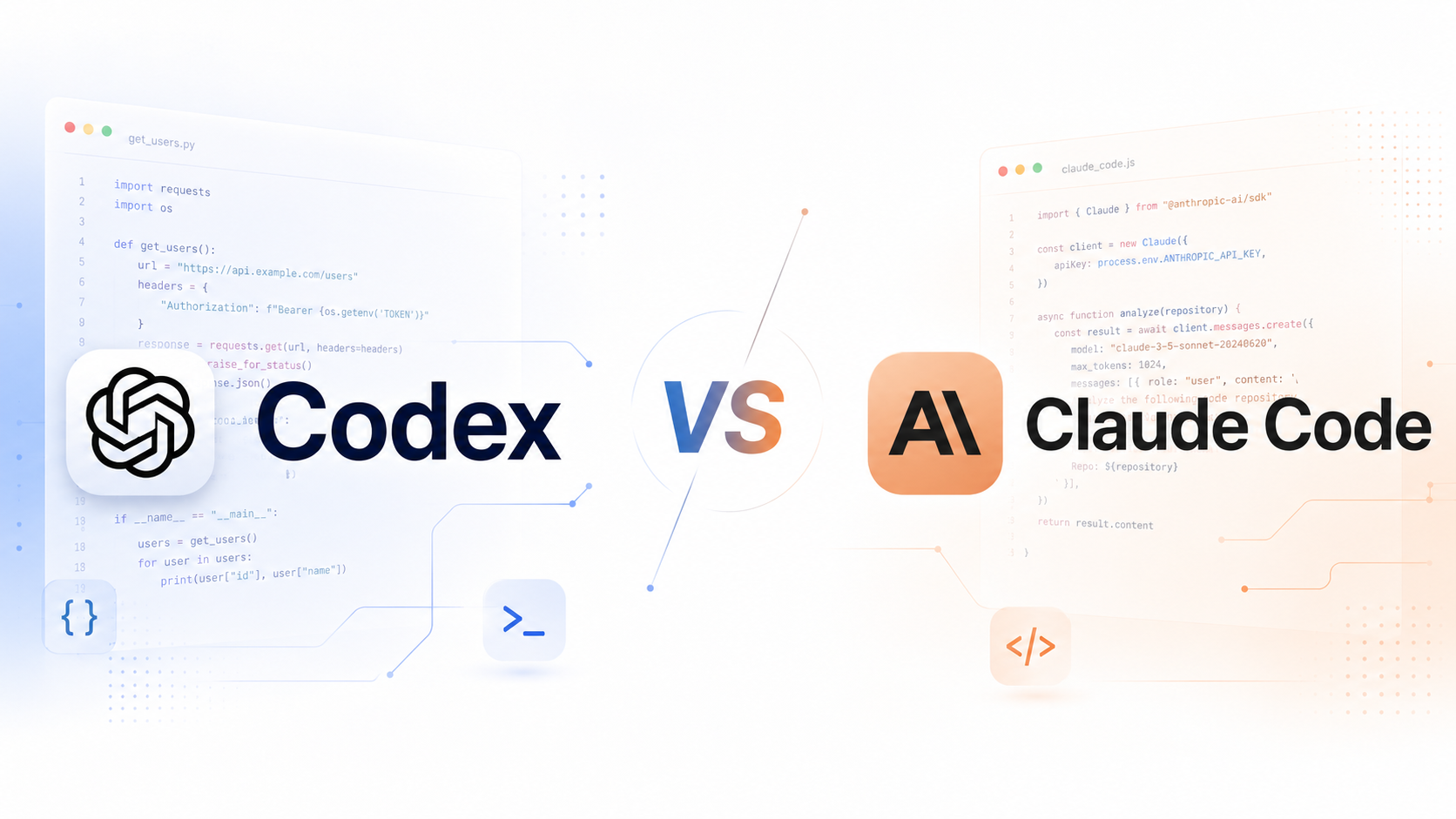
Among the most talked-about tools in this space are OpenAI Codex and Claude Code. While both are designed to improve developer productivity, they take different approaches to solving software engineering problems.
Codex focuses on executing coding tasks with minimal manual intervention, making it well suited for developers who want an AI agent capable of writing, editing, and managing code across projects. Claude Code, on the other hand, emphasizes deep code understanding, long-context reasoning, and collaborative problem-solving, making it particularly useful for navigating large and complex codebases.
The challenge is that neither tool is universally better. A solo developer building side projects may prioritize speed and automation, while an engineering team maintaining a large enterprise application may value repository understanding and architectural reasoning more highly.
That's why this comparison doesn't rely on marketing claims or feature lists alone. Instead, we'll evaluate both AI coding agents across the areas developers care about most, including:
- Code generation quality
- Repository understanding
- Refactoring capabilities
- Debugging performance
- Terminal workflows
- IDE integrations
- Security and privacy
- Pricing
- Team collaboration
- Real-world development scenarios
By the end of this guide, you'll understand where each AI coding agent performs best, the trade-offs between them, and which one is likely to fit your development workflow.
Codex vs Claude Code Comparison
| Category | Codex | Claude Code |
| Developer | OpenAI | Anthropic |
| Primary Purpose | AI coding agent for development workflows | AI coding assistant focused on reasoning and code understanding |
| Best For | Automating coding tasks and software development workflows | Large repositories, code analysis, and architectural reasoning |
| Code Generation | Excellent | Excellent |
| Multi-file Editing | Yes | Yes |
| Repository Understanding | Strong | Excellent |
| Debugging | Excellent | Excellent |
| Refactoring | Excellent | Very Good |
| Terminal Support | Yes | Yes |
| Git Integration | Yes | Yes |
| Enterprise Use | Yes | Yes |
Why This Comparison Matters
AI coding tools are becoming a standard part of modern AI development. From startups shipping MVPs to enterprise engineering teams maintaining large applications, developers increasingly rely on AI to reduce repetitive work, improve code quality, and accelerate delivery.
Choosing the wrong tool can slow your workflow or leave important capabilities unused. Before investing time or money, it's worth understanding how each platform performs in practical development environments.
This comparison is designed for:
- Software Engineers
- Full-Stack Developers
- Backend Developers
- Frontend Developers
- DevOps Engineers
- Engineering Managers
- Startup Founders
- Freelance Developers
- Technical Consultants
Whether you are building a React application, maintaining a large Java service, working with Python automation scripts, or managing a multi-service architecture, understanding the strengths of each AI coding agent can help you choose the right tool for your workflow.
What Is OpenAI Codex?
OpenAI Codex is an AI-powered coding agent developed by OpenAI to help developers complete software engineering tasks through natural language instructions.
Instead of simply predicting the next line of code, Codex is designed to understand development objectives and assist throughout the software development lifecycle. It can generate code, modify existing files, explain unfamiliar implementations, create tests, and help automate repetitive engineering work.
Depending on the workflow, developers may use Codex to:
- Build new application features
- Refactor legacy code
- Identify and fix bugs
- Generate unit tests
- Improve documentation
- Automate repetitive coding tasks
- Work across multiple project files
The goal is to reduce manual effort while allowing developers to stay focused on solving higher-level engineering problems.
What Is Claude Code?
Claude Code is Anthropic's AI coding assistant built to support developers working with real-world software projects. It combines code generation with strong reasoning capabilities, making it particularly effective when analyzing complex systems, understanding project architecture, and assisting with technical decision-making.
Rather than focusing only on writing code, Claude Code aims to help developers understand why code works, identify potential issues, review implementations, and navigate large repositories more efficiently.
Common use cases include:
- Exploring unfamiliar codebases
- Reviewing pull requests
- Refactoring existing applications
- Debugging complex issues
- Generating implementation plans
- Creating technical documentation
- Explaining legacy code
Its ability to process extensive project context makes it especially valuable for teams working on large or long-lived software systems.
How We'll Compare Codex and Claude Code
To provide a balanced evaluation, we'll compare both tools across the criteria that matter most in day-to-day development:
- Core features and capabilities
- Code generation quality
- Debugging and error resolution
- Repository and context understanding
- Refactoring performance
- Supported programming languages
- IDE and terminal integration
- Git and version control workflows
- Security and privacy
- Pricing and value for money
- Best use cases for individuals and teams
Rather than declaring a single winner, the goal is to highlight where each tool performs well so you can choose the one that aligns with your workflow, team size, and development priorities.
Codex vs Claude Code: Feature-by-Feature Comparison
On paper, Codex and Claude Code appear to offer many of the same capabilities. Both can generate code, explain existing implementations, assist with debugging, and work across multiple files.
However, developers rarely choose a coding agent based on feature checklists alone. The real difference becomes clear when these tools are used in everyday development workflows-whether you're implementing a new feature, reviewing a pull request, refactoring a legacy module, or trying to understand a codebase you've never seen before.
The sections below compare how each AI coding agent approaches these common software engineering tasks.
Development Philosophy
Before comparing individual features, it's helpful to understand the design philosophy behind each tool.
OpenAI Codex
Codex is designed to help developers complete engineering tasks efficiently. Instead of focusing only on answering programming questions, it aims to assist with implementation by generating code, modifying project files, writing tests, and supporting multi-step development workflows.
Its approach is centered around helping developers move from a task description to a working implementation with minimal manual effort.
Claude Code
Claude Code places greater emphasis on understanding software before changing it. It is particularly effective at analyzing project architecture, explaining implementation decisions, identifying dependencies, and helping developers reason through technical problems before making modifications.
This makes it especially useful when working with unfamiliar or long-lived codebases.
Developer Perspective
Neither philosophy is inherently better.
If your work primarily involves shipping new features, Codex's implementation-focused workflow may feel more natural. If your day-to-day work involves understanding complex systems before making changes, Claude Code's reasoning-first approach can be equally valuable.
Code Generation
Generating functional code is now a baseline expectation for modern AI coding tools. What matters more is whether the generated code is readable, maintainable, and consistent with the surrounding project.
| Capability | Codex | Claude Code |
| Generates complete functions | ✔ | ✔ |
| Creates reusable components | ✔ | ✔ |
| Produces structured code | ✔ | ✔ |
| Explains generated code | Limited | Extensive |
| Handles multi-file implementations | ✔ | ✔ |
Codex
Codex performs well when developers already know what they want to build. It can translate feature requests into implementation, generate supporting files, and assist throughout the development process.
For example, if asked to add authentication to an existing application, Codex can typically generate the required routes, middleware, configuration changes, and related updates within the same workflow.
Claude Code
Claude Code also generates production-ready code but generally provides more context around its implementation choices. Rather than only producing output, it often explains design decisions and highlights potential trade-offs.
Developers who value understanding the reasoning behind generated code may find this approach beneficial.
Practical Takeaway
If your goal is rapid implementation, Codex aligns well with that workflow.
If understanding the implementation is just as important as producing it, Claude Code offers additional context that many developers appreciate.
Working Across Large Codebases
As projects grow, understanding relationships between files becomes increasingly important.
Codex
Codex can navigate project structure and modify related files within a single development task. This makes it useful for feature implementation that spans multiple components.
Examples include:
- Updating APIs
- Modifying business logic
- Editing configuration files
- Generating tests
- Updating documentation
Claude Code
Claude Code is particularly strong when exploring existing projects.
Instead of immediately suggesting changes, it often analyzes:
- Project architecture
- Module dependencies
- File relationships
- Existing coding patterns
- Overall system design
This can reduce the time developers spend understanding unfamiliar repositories before making modifications.
Practical Takeaway
Developers implementing new functionality may appreciate Codex's ability to coordinate changes across multiple files.
Teams maintaining mature applications may benefit from Claude Code's emphasis on understanding project structure before implementation.
Refactoring Existing Code
Refactoring is one of the most demanding software engineering tasks because changes must improve code quality without altering application behavior.
Codex
Codex is well suited for implementation-focused refactoring.
It can assist with tasks such as:
- Removing duplicated logic
- Extracting reusable functions
- Updating deprecated APIs
- Improving project consistency
- Modernizing legacy code
Claude Code
Claude Code approaches refactoring from a more analytical perspective.
Before suggesting changes, it often explains:
- Why the existing implementation could be improved
- Potential side effects
- Architectural considerations
- Alternative implementation strategies
This additional context can be valuable during larger refactoring initiatives where understanding the impact of changes is critical.
Practical Takeaway
If you're already confident about the desired outcome, Codex helps accelerate implementation.
If you're evaluating different approaches before making structural changes, Claude Code provides more discussion around the available options.
Debugging Assistance
Finding a bug is only part of the problem. Understanding why it occurs is often the more difficult task.
Codex
Codex is effective when developers have already identified the failing functionality.
It can help:
- Trace errors
- Suggest fixes
- Update related files
- Generate regression tests
- Reduce repetitive debugging work
Claude Code
Claude Code spends more time explaining how an issue propagates through the application.
Instead of focusing solely on the fix, it often discusses:
- Execution flow
- Dependency relationships
- Possible edge cases
- Alternative solutions
This can be particularly useful when debugging large applications where the visible error originates far from the actual cause.
Practical Takeaway
For fast implementation of known fixes, Codex can streamline the workflow.
For investigating complex issues or understanding application behavior, Claude Code often provides additional context that supports better technical decisions.
Multi-File Development
Modern software features rarely involve editing just one file.
Adding authentication, implementing payments, introducing caching, or creating a new API usually requires coordinated changes throughout the project.
Both Codex and Claude Code support multi-file development.
The difference lies in how they approach the process.
Codex tends to focus on completing implementation tasks efficiently, while Claude Code emphasizes understanding how each modification affects the broader application before proposing changes.
Developer Perspective
Neither workflow is universally better.
The right choice depends on whether your priority is executing implementation tasks quickly or spending additional time analyzing system behavior before making changes.
Feature Comparison
| Development Area | Codex | Claude Code |
| Feature Implementation | Strong implementation workflow | Strong analytical workflow |
| Code Generation | Production-ready output | Production-ready output with detailed explanations |
| Repository Understanding | Handles project-wide changes effectively | Excels at understanding complex repositories |
| Refactoring | Focused on implementation | Focused on reasoning and impact analysis |
| Debugging | Efficient for resolving known issues | Strong at explaining root causes |
| Multi-file Development | Well suited for coordinated implementation | Well suited for architectural analysis |
What This Means for Developers
Choosing between Codex and Claude Code isn't about finding a universal "winner."
Instead, it comes down to the type of development work you do most often.
If your workflow revolves around building features, implementing tickets, and automating repetitive engineering tasks, Codex's execution-oriented approach may fit naturally into your development process.
If your work involves understanding unfamiliar repositories, reviewing complex systems, planning refactors, or collaborating on long-lived codebases, Claude Code's emphasis on reasoning and code comprehension may provide greater value.
Both tools are capable AI coding agents, making them valuable for businesses investing in AI agent development. The better choice depends less on the number of features they offer and more on how closely their workflow matches your own.
Real-World Developer Experience: Codex vs Claude Code
The best AI coding agent isn't necessarily the one with the longest feature list. It's the one that integrates naturally into your development workflow and reduces the time spent switching between planning, coding, debugging, and reviewing.
To understand the practical differences, let's compare how Codex and Claude Code perform in common software engineering scenarios.
Scenario 1: Building a New Feature
Imagine you're asked to add a user profile page to an existing SaaS application.
The task involves:
- Creating new routes
- Updating backend logic
- Designing database models
- Writing API endpoints
- Updating frontend components
- Adding validation
- Writing tests
Using Codex
Codex is designed to help move this type of task from requirement to implementation. It can work across related files, generate supporting code, and help maintain consistency throughout the feature.
For developers who prefer assigning implementation tasks and reviewing the output, this workflow can reduce repetitive coding.
Using Claude Code
Claude Code approaches the same task by first understanding the existing application structure. It may explain how the new feature fits into the architecture, identify dependencies, and recommend implementation patterns before generating code.
This additional context can help teams maintain consistency in larger projects.
Developer Perspective
If your priority is shipping new features quickly, Codex's workflow may feel more implementation-focused.
If you're working within a mature application where architectural consistency matters, Claude Code's reasoning-first approach can help reduce design mistakes.
Scenario 2: Understanding an Existing Codebase
Many developers spend more time reading code than writing it.
This is especially true when:
- Joining a new company
- Inheriting legacy software
- Reviewing open-source projects
- Maintaining enterprise applications
Codex
Codex can explain functions, trace dependencies, and summarize implementations while helping developers navigate unfamiliar projects.
Claude Code
Claude Code is particularly effective when the objective is understanding how different parts of a system interact. Rather than focusing only on individual files, it often provides broader explanations about architecture, module relationships, and overall project organization.
Developer Perspective
For developers onboarding to large repositories, Claude Code's emphasis on code comprehension may reduce the learning curve.
Scenario 3: Debugging a Production Issue
Suppose users report that checkout requests are failing after a recent deployment.
The issue could involve:
- Backend services
- API routes
- Database queries
- Authentication
- Third-party integrations
Codex
Codex can assist in tracing the issue, identifying relevant files, proposing code changes, and helping generate tests that reduce the likelihood of regression.
Claude Code
Claude Code often spends more time explaining why the failure occurred and how different components contributed to the problem before suggesting modifications.
For complex production issues, this additional reasoning can provide valuable context during investigation.
Developer Perspective
Both tools support debugging effectively, but their workflows differ.
Codex emphasizes implementing fixes, while Claude Code places greater emphasis on understanding the underlying cause.
Scenario 4: Refactoring Legacy Software
Legacy applications often contain duplicated logic, inconsistent naming, outdated libraries, and technical debt accumulated over years of development.
Codex
Codex helps automate repetitive refactoring tasks by updating related files, replacing deprecated implementations, and generating cleaner code structures.
Claude Code
Claude Code focuses on evaluating the impact of proposed changes before implementation. It often explains trade-offs, identifies architectural concerns, and discusses alternative refactoring strategies.
Developer Perspective
For straightforward modernization tasks, Codex can reduce manual effort.
For larger architectural refactoring, Claude Code's detailed reasoning may support better technical planning.
Developer Workflow Comparison
| Workflow Stage | Codex | Claude Code |
| Building new features | Strong implementation support | Structured planning with implementation guidance |
| Exploring unfamiliar projects | Explains code and project structure | Deep architectural understanding |
| Debugging applications | Helps identify and implement fixes | Explains root causes and dependencies |
| Refactoring | Efficient implementation | Analytical approach with impact assessment |
| Documentation | Generates technical documentation | Produces detailed explanations and documentation |
IDE and Development Environment
An AI coding agent should integrate naturally into the tools developers already use.
When evaluating Codex or Claude Code, consider questions such as:
- Does it fit your preferred editor?
- Can it work alongside your existing Git workflow?
- Does it support terminal-based development?
- How much context does it retain during longer coding sessions?
The answers may influence your daily productivity more than individual features.
Rather than switching tools, many developers prefer an AI assistant that becomes part of their existing workflow, reducing friction instead of introducing it.
Learning Curve
Even powerful AI tools require some adjustment before developers can use them effectively.
Codex
Developers familiar with AI-assisted coding may find Codex relatively straightforward for implementation-focused tasks. Writing clear prompts and breaking work into manageable objectives generally produces better results than broad, open-ended requests.
Claude Code
Claude Code rewards developers who provide additional project context and ask exploratory questions. Teams that regularly discuss architecture, design decisions, or implementation trade-offs may find its conversational workflow particularly helpful.
What This Means for Teams
Individual developers often prioritize speed, while engineering teams typically value consistency, maintainability, and shared understanding.
In collaborative environments, the choice between Codex and Claude Code may depend on how your team works rather than which tool offers more features.
Teams focused on rapid delivery may prefer an implementation-oriented workflow, while teams maintaining complex systems may benefit from deeper code understanding and architectural reasoning.
Neither approach replaces good engineering practices they simply support different stages of the development process.
IDE, Integrations, Security & Pricing: Codex vs Claude Code
Choosing an AI coding agent isn't just about how well it writes code. It also needs to fit naturally into your development environment, integrate with your existing tools, and align with your team's security and budget requirements.
Whether you're an independent developer using VS Code or part of an enterprise engineering team managing hundreds of repositories, these practical considerations can influence your long-term experience more than individual features.
Programming Language Support
Both Codex and Claude Code are designed to work with a wide range of modern programming languages. Instead of being limited to one ecosystem, they assist developers across frontend, backend, mobile, scripting, and infrastructure projects.
| Language | Codex | Claude Code |
| JavaScript & TypeScript | Supported | Supported |
| Python | Supported | Supported |
| Java | Supported | Supported |
| C# | Supported | Supported |
| Go | Supported | Supported |
| PHP | Supported | Supported |
| Ruby | Supported | Supported |
| Rust | Supported | Supported |
| Swift | Supported | Supported |
| Kotlin | Supported | Supported |
Developer Perspective
For most software projects, language support is unlikely to be the deciding factor. Both tools are capable of working across the programming languages commonly used in modern application development.
Instead, the difference is more noticeable in how each tool understands project context and assists during implementation.
Framework Compatibility
Modern development involves frameworks and libraries just as much as programming languages.
Developers commonly use AI coding agents with frameworks such as:
- React
- Next.js
- Vue
- Angular
- Node.js
- Express
- Django
- Flask
- Laravel
- Spring Boot
- ASP.NET Core
- Ruby on Rails
Both Codex and Claude Code can assist with these ecosystems by generating components, explaining framework-specific patterns, and helping developers navigate project structures.
IDE Experience
A coding agent becomes significantly more useful when it fits naturally into the tools developers already use.
Instead of forcing engineers to switch contexts, the best AI assistants reduce interruptions and support existing workflows.
Some of the most commonly used development environments include:
- Visual Studio Code
- Cursor
- Windsurf
- JetBrains IDEs
- Terminal-based development environments
Both Codex and Claude Code are designed to work alongside modern developer workflows rather than replacing them.
Developer Perspective
When evaluating either tool, consider:
- How much time do you spend inside your editor?
- Do you prefer chat-based interaction or task-oriented workflows?
- How often do you switch between terminal, editor, and documentation?
The answers to these questions will often have a greater impact on productivity than the feature list itself.
Git and Version Control Workflows
Version control is central to modern software development.
Developers frequently use AI while:
- Reviewing pull requests
- Resolving merge conflicts
- Updating feature branches
- Explaining code changes
- Writing commit messages
- Understanding project history
Both Codex and Claude Code can support Git-based development workflows, helping developers understand changes and accelerate implementation.
Security and Privacy Considerations
Security becomes increasingly important when AI tools interact with production code or proprietary repositories.
Organizations evaluating AI coding agents should consider:
- Access permissions
- Repository privacy
- Data handling policies
- Administrative controls
- Enterprise deployment options
- Compliance requirements
These factors often matter more to enterprise engineering teams than individual productivity features.
Questions Worth Asking
Before adopting any AI coding agent, consider:
- Can administrators control access?
- How is project data handled?
- Are enterprise security controls available?
- Does the platform align with your organization's compliance requirements?
The answers will vary depending on deployment model and subscription plan, so it's worth reviewing the official documentation before introducing an AI coding tool into production workflows.
Pricing Considerations
Pricing is an important factor, but it should be evaluated alongside productivity gains rather than in isolation.
When comparing AI coding tools, consider the total value they provide through:
- Reduced development time
- Faster debugging
- Improved documentation
- Quicker onboarding
- Better code consistency
- Increased developer productivity
Subscription costs are relatively easy to compare. Measuring the long-term impact on engineering efficiency is often more valuable.
Individual Developers vs Engineering Teams
The needs of a solo developer differ significantly from those of an enterprise software team.
| Team Type | What Matters Most |
| Freelancers | Speed, affordability, ease of use |
| Startup Teams | Rapid feature delivery and iteration |
| Growing Companies | Collaboration and maintainability |
| Enterprise Organizations | Security, governance, scalability, compliance |
Neither Codex nor Claude Code is designed for only one type of user.
The better choice depends on your development process, collaboration model, and operational requirements.
Beyond Features: Choosing the Right Workflow
After comparing languages, frameworks, integrations, security, and pricing, one pattern becomes clear:
The decision isn't really about which tool offers more features.
It's about which workflow aligns with the way your team builds software.
Some developers prefer assigning implementation tasks and reviewing completed work. Others prefer understanding architecture, discussing implementation options, and making design decisions before writing code.
Both approaches are valid, and modern AI coding agents increasingly support different styles of software engineering rather than competing on a single capability.
Choosing Between Codex and Claude Code
After comparing their capabilities, one thing becomes clear: Codex and Claude Code are built for different development workflows.
Both tools can generate code, explain implementations, assist with debugging, and work across large projects. The difference lies in how they support developers throughout the software development lifecycle.
Where Codex Fits Best
Codex is well suited to developers and teams that prioritize implementation and workflow automation.
You may find Codex a good fit if your work regularly involves:
- Building new product features
- Creating APIs and backend services
- Writing unit and integration tests
- Automating repetitive development tasks
- Working across multiple project files
- Maintaining fast release cycles
For teams following Agile development practices, Codex can reduce time spent on repetitive implementation work while allowing engineers to focus on architecture, business logic, and code reviews.
Where Claude Code Fits Best
Claude Code is particularly valuable when software development begins with understanding rather than implementation.
It may be a strong choice if your workflow frequently includes:
- Exploring unfamiliar repositories
- Maintaining enterprise applications
- Reviewing pull requests
- Planning large refactoring initiatives
- Understanding complex architecture
- Creating technical documentation
Engineering teams responsible for long-lived software systems often spend significant time reading existing code before making changes. Claude Code is designed to support that phase of development.
Comparing Development Workflows
Instead of thinking about features, consider which workflow sounds closer to your daily work.
| Development Activity | Codex | Claude Code |
| Implementing new features | Designed to streamline implementation tasks | Supports implementation with additional architectural context |
| Understanding large repositories | Provides project awareness during implementation | Emphasizes repository exploration and system understanding |
| Refactoring existing applications | Helps automate implementation changes | Encourages evaluating design decisions before modification |
| Debugging production issues | Assists with tracing and implementing fixes | Explains application behavior and possible root causes |
| Technical documentation | Generates documentation from code | Produces detailed explanations and implementation rationale |
Neither workflow is inherently better. The right choice depends on how your team approaches software development.
Considerations Before Choosing an AI Coding Agent
Before committing to any AI coding tool, consider these practical questions.
How much of your work involves existing code?
If most of your time is spent maintaining mature applications, understanding project architecture may be just as important as generating new code.
How frequently do you build new features?
Teams shipping frequent releases may value implementation efficiency more than extended architectural discussions.
Does your team follow consistent engineering standards?
AI coding agents are most effective when projects already have:
- Clear folder structures
- Coding conventions
- Testing practices
- Documentation standards
- Review processes
Well-organized repositories generally produce more predictable AI-assisted development.
Will multiple developers use the tool?
The needs of an individual developer differ from those of an engineering organization.
Enterprise teams often evaluate:
- Administrative controls
- Security requirements
- Collaboration workflows
- Compliance obligations
- Scalability
Individuals may place greater emphasis on simplicity and day-to-day productivity.
Conclusion
The rise of AI coding agents is changing how software is built, but selecting the right tool is less about finding a universal winner and more about finding the right fit.
If your daily work centers on implementing features and accelerating development, an execution-oriented workflow may suit you best.
If your projects require understanding complex architectures, reviewing existing systems, and making carefully considered design decisions, a reasoning-focused workflow may offer greater long-term value.
Ultimately, the most effective AI coding assistant is the one that integrates naturally into your team's engineering process and helps developers spend more time solving meaningful problems rather than repetitive coding tasks. As AI-powered workflows continue to evolve, advancements in MCP development are expected to improve how coding agents interact with external tools, repositories, and enterprise systems.