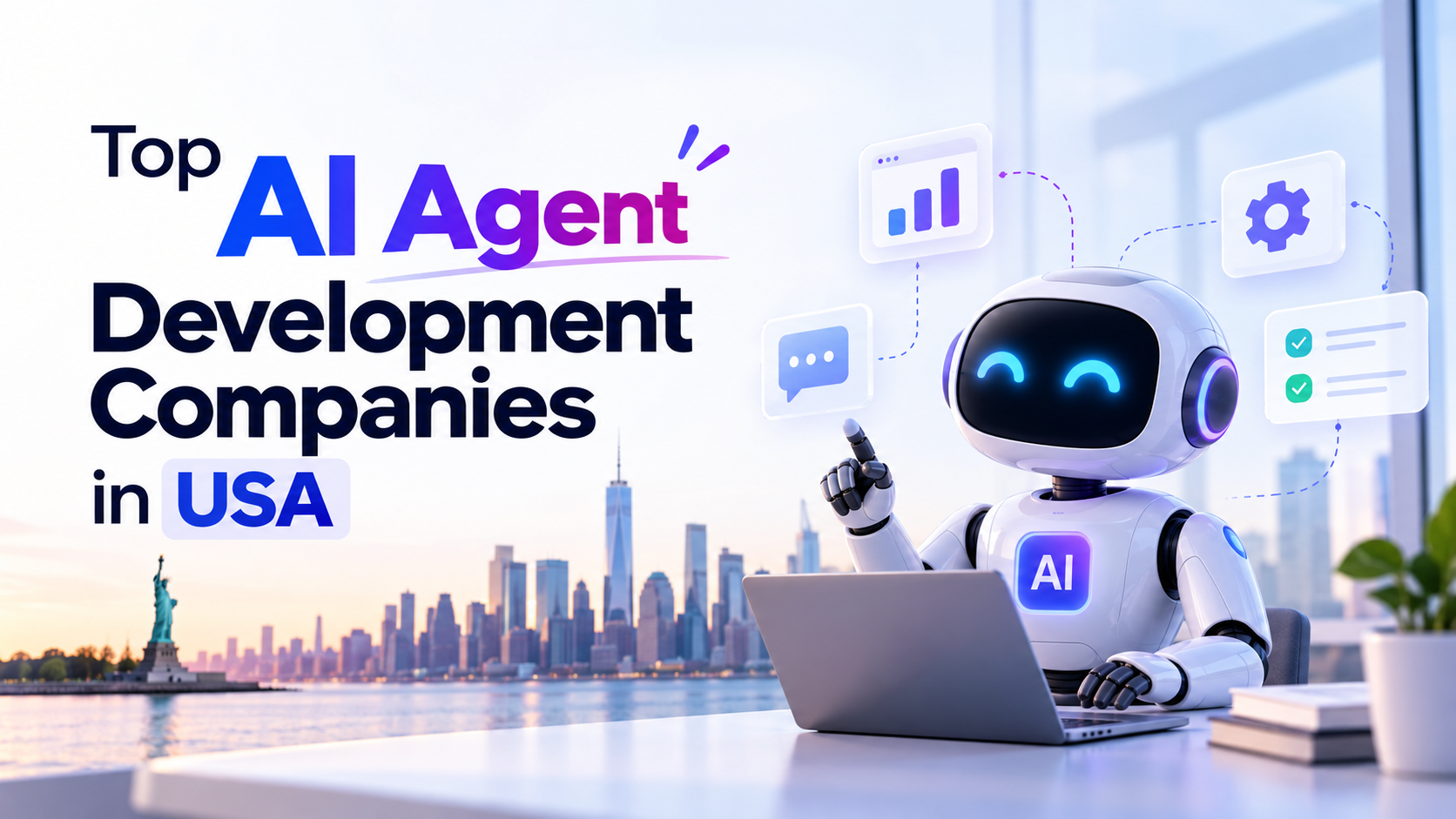
Businesses are looking beyond traditional chatbots and experimenting with AI agents that can work across applications, retrieve business information, follow defined workflows, and complete multi-step tasks. The challenge is finding a development partner that can turn an AI concept into a dependable system that works with existing business software.
The companies below offer different approaches to AI agent development, from custom engineering and multi-agent systems to enterprise AI consulting. The comparison prioritizes publicly described services, integration capabilities, production deployment, security practices, and the type of organization each provider may suit. It is a curated shortlist, not an independently audited industry ranking.
What Are AI Agent Development Companies?
AI agent development companies design and build software agents that can interpret goals, use approved tools, access relevant data, and carry out defined tasks with varying levels of autonomy. Unlike a basic chatbot that mainly responds to questions, an AI agent can be designed to perform actions such as updating CRM records, processing support requests, reviewing documents, or coordinating steps across multiple systems.
A development engagement may include business analysis, agent architecture, large language model integration, retrieval-augmented generation (RAG), API connections, testing, deployment, monitoring, and ongoing maintenance.
The right approach depends on the use case. Some businesses need a single agent to handle one well-defined workflow, while others need several specialized agents coordinated across departments. In either case, permissions, testing, human approval, and monitoring should be part of the design-not added after deployment.
How We Selected These AI Agent Development Companies
This shortlist uses a practical evaluation framework for US businesses comparing development partners:
- AI agent capabilities: Publicly described experience with custom agents, agentic workflows, or multi-agent systems.
- Integration expertise: Ability to connect agents with APIs, databases, CRM platforms, enterprise applications, and existing workflows.
- Production readiness: Services covering testing, deployment, monitoring, governance, or ongoing support.
- Business fit: Relevance to startups, growing companies, mid-market organizations, or large enterprises.
- Public evidence: Official service pages, documented projects, certifications, and other verifiable information.
Top 10 AI Agent Development Companies in USA
| Company | Best suited for | Main focus |
| Web Panel Solutions | Custom digital products and AI-enabled workflows | Software development and integrations |
| Master of Code Global | Enterprise AI agents | Custom agents and workflow automation |
| LeewayHertz | Complex agentic AI projects | Multi-agent systems and enterprise integration |
| Markovate | Business process automation | Agentic AI and custom AI solutions |
| ScienceSoft | Regulated and data-intensive industries | AI agents, governance, and enterprise software |
| Azumo | Mid-market and enterprise teams | Custom AI engineering and agent orchestration |
| SoluLab | Custom single-agent and multi-agent solutions | Agent development and workflow integration |
| HatchWorks AI | AI-native product development | Agentic automation and AI-led engineering |
| Simform | Enterprise AI engineering | Agentic systems and software integration |
| IBM Consulting | Large-scale enterprise transformation | Agentic AI strategy, governance, and integration |
1. Web Panel Solutions
Best for: Custom software, digital products, and AI-enabled business workflows
Web Panel Solutions provides web development, ecommerce development, mobile application development, and custom software services. These capabilities can be relevant to businesses planning an AI-enabled product that needs a user interface, backend development, API integrations, and connections to existing business systems.
For an AI agent project, the scope may involve more than selecting a language model. The surrounding application must handle user access, data exchange, business rules, error handling, and the points at which a human needs to review an agent's actions.
Key Services
- Custom software and web application development
- AI-enabled application development
- API and third-party system integration
- Business workflow automation
- Mobile application development
- Application maintenance and support
Why Consider Web Panel Solutions?
Web Panel Solutions may suit businesses that need application development and integration work alongside an AI initiative. Companies considering it for a dedicated AI agent project should ask for relevant agent-development case studies, the proposed technology stack, testing procedures, and details of post-launch monitoring before making a decision.
Ideal For
Startups and growing businesses developing custom digital products, business applications, or AI-enabled workflows.
2. Master of Code Global
Best for: Enterprise AI agents and complex business workflows
Master of Code Global offers AI agent development across consulting, architecture, custom development, integration, deployment, and support. Its service offering focuses on agents that operate within existing enterprise systems rather than remaining isolated assistants. The company also publishes information about security controls, monitoring, and human oversight.
Its approach is relevant when an organization needs an agent to coordinate several steps—for example, retrieving customer information, checking business rules, updating an internal system, and escalating exceptions for human review.
Key Services
- Custom AI agent development
- Agentic AI architecture
- Enterprise system integration
- Multi-step workflow automation
- AI agent evaluation and monitoring
- Deployment and ongoing support
Why Consider Master of Code Global?
Master of Code Global publishes a portfolio of AI-related projects, including an internal MCP solution designed to bring enterprise tools into a shared conversational workspace. Its stated delivery approach also includes pilot development, security controls, and monitoring.
Ideal For
Mid-sized and large businesses developing enterprise agents, internal assistants, and connected automation workflows.
3. LeewayHertz
Best for: Custom agentic AI and multi-agent systems
LeewayHertz provides AI agent development services covering use-case analysis, technical design, custom development, integration, deployment, and operational management. Its published offering includes both individual agents and multi-agent systems built around specific business processes.
A multi-agent system divides work among specialized agents. One agent might retrieve information, another might analyze it, and a coordinating agent might organize the results or request approval before a business action takes place. This architecture can help with complex workflows, although it also introduces additional testing and orchestration requirements.
Key Services
- AI strategy and consulting
- Custom AI agent development
- Multi-agent system development
- Enterprise data and application integration
- Agent evaluation and monitoring
- Governance and deployment support
Why Consider LeewayHertz?
LeewayHertz describes a development process that addresses architecture, security controls, integration interfaces, observability, and production requirements. This is particularly relevant to organizations that need to plan how agents will behave after deployment, not just how they perform in a demonstration.
Ideal For
Enterprises building complex AI workflows that span several applications, teams, or data sources.
4. Markovate
Best for: Custom AI agents and business process automation
Markovate offers agentic AI development focused on workflow automation, decision support, and coordinating tasks across business operations. Its published services include custom AI solutions and proof-of-concept work, giving businesses a way to assess an idea before committing to a broader implementation.
This can be useful for companies that already have a defined operational problem but need help deciding how much autonomy an AI system should have. A proof of concept can test the agent against representative tasks, available data, and required integrations before the organization expands the project.
Key Services
- Custom AI agent development
- Agentic workflow automation
- AI proof-of-concept development
- Voice AI solutions
- Decision-support systems
- AI integration and implementation
Why Consider Markovate?
Markovate publishes examples involving ERP order processing and voice-based customer interactions. These examples suggest a focus on practical business workflows rather than only general-purpose conversational tools. Prospective customers should review the relevant project details and ask how the reported results were measured.
Ideal For
Businesses seeking targeted automation for operations, customer interactions, or workflows that involve several steps.
5. ScienceSoft
Best for: Regulated industries and enterprise AI systems
ScienceSoft develops custom AI agents that connect with enterprise applications and data while following defined business rules and security requirements. The company also publishes AI project examples involving lending, healthcare scheduling, investment analysis, and other data-intensive workflows.
For organizations in regulated sectors, the development challenge includes more than model performance. Data access, traceability, privacy requirements, error handling, and human review can all affect whether an agent is suitable for real operations.
Key Services
- Custom AI agent development
- AI consulting and proof-of-concept delivery
- Enterprise application integration
- AI security and compliance support
- Voice and conversational AI
- AI optimization and maintenance
Why Consider ScienceSoft?
ScienceSoft publishes a case study describing a suite of AI agents for Atlas Credit, a Texas-based consumer lending provider, with an emphasis on governance and controlled automation. Its broader AI portfolio also includes a healthcare scheduling voice agent. These examples provide prospective customers with concrete projects to examine when assessing industry fit.
Ideal For
Healthcare, financial services, insurance, and other organizations where data handling, oversight, and dependable integration are central requirements.
6. Azumo
Best for: Custom AI engineering and enterprise workflow integration
Azumo develops AI agents for business workflows that may involve multiple models, tools, and data sources. Its published technical approach includes orchestration frameworks such as LangGraph, CrewAI, and Microsoft AutoGen, alongside configurable levels of autonomy and human review.
This engineering focus can be useful for organizations that have already identified a workflow and need a team to build, integrate, and deploy the system. Buyers should also determine whether the proposed engagement includes ongoing operations or primarily covers initial development.
Key Services
- Custom AI agent development
- Multi-agent orchestration
- AI application development
- Model and API integration
- Dedicated AI engineering teams
- Production deployment
Why Consider Azumo?
Azumo states that it has been building AI solutions since 2016 and reports more than 300 successful deployments. It also publishes information about its SOC 2 certification and AI engineering services. Businesses should verify the specific scope of relevant experience and certification during procurement.
Ideal For
Mid-market and enterprise teams that need custom AI engineering, dedicated development capacity, or agent workflows connected to existing software.
7. SoluLab
Best for: Custom agents and multi-agent business applications
SoluLab offers development services for single-agent and multi-agent systems, including integration, model optimization, orchestration, monitoring, and support. Its published examples include UpdateIA, an AI ecosystem described as coordinating multiple specialized agents across business functions.
The company is worth evaluating when a business needs an agent designed around a specific operational process rather than a general assistant. As with any provider's published performance claims, buyers should request case-study details and confirm whether the reported results match their own use case.
Key Services
- Custom AI agent development
- Multi-agent system development
- AI workflow automation
- Agent integration and orchestration
- AI model optimization
- Support and maintenance
Why Consider SoluLab?
SoluLab describes a development process that includes guardrails, evaluation, human approval for higher-risk actions, and ongoing monitoring. These capabilities are important when agents can update business records, initiate transactions, or affect customer-facing operations.
Ideal For
Companies exploring custom AI automation across customer service, internal operations, ecommerce, or business applications.
8. HatchWorks AI
Best for: AI-native products and agentic automation
HatchWorks AI focuses on AI-led software development, data modernization, model optimization, and agentic automation. Its service model includes AI strategy, product development, and dedicated engineering approaches for organizations building or modernizing software around AI capabilities.
Rather than treating AI as a feature added at the end of development, this approach considers how AI capabilities fit into the product's architecture, data foundation, and ongoing engineering process.
Key Services
- Agentic AI automation
- AI-native product development
- AI strategy and roadmapping
- Data modernization
- Model fine-tuning and optimization
- AI-focused engineering teams
Why Consider HatchWorks AI?
HatchWorks AI may be a fit for businesses building new AI-enabled products or changing how existing software is developed. Its published services emphasize the combination of AI strategy, engineering, and adoption. Buyers should clarify how agent design, testing, integration, and post-launch ownership will be handled within the proposed engagement.
Ideal For
Product teams and growing companies developing AI-native software or introducing agentic automation into existing products.
9. Simform
Best for: Enterprise software engineering and agentic AI delivery
Simform provides software engineering and AI development services and has published a comparison of agentic AI development partners. Its discussion distinguishes custom development partners from foundation-model providers and platforms, highlighting the need for integration, governance, evaluation, and production operations.
That distinction matters for businesses that already have access to an AI model or cloud platform but lack the engineering resources to turn it into a reliable business application.
Key Services
- AI and agentic system development
- Enterprise software engineering
- AI integration
- Workflow automation
- AI application delivery
- Production readiness and optimization
Why Consider Simform?
Simform's published material focuses on moving beyond prototypes toward systems that connect to enterprise data, operate within defined boundaries, and can be evaluated and maintained after launch. Businesses should review its specific project examples and confirm which services are included in a proposed agent-development engagement.
Ideal For
Organizations that need an engineering partner to connect AI capabilities with existing software and operational workflows.
10. IBM Consulting
Best for: Large enterprises and governed AI transformation
IBM Consulting helps organizations design, build, integrate, and scale AI and agentic AI solutions. Its services cover strategy, data readiness, governance, AI-powered applications, and integration across enterprise systems. IBM also publishes work involving customer service, finance, supply chain, and IT operations.
Large organizations often have multiple business applications, different data access policies, and established compliance requirements. In these environments, an agent-development project may require coordination across departments, cloud infrastructure, governance teams, and existing technology vendors.
Key Services
- Enterprise AI and agentic AI consulting
- AI strategy and governance
- AI agent integration
- Data and AI modernization
- Enterprise workflow automation
- AI deployment and operational support
Why Consider IBM Consulting?
IBM's published services emphasize integration, governance, and scaling AI across business processes. Its enterprise focus may be particularly relevant when an organization is coordinating multiple AI systems or needs to align agent development with a broader technology transformation.
Ideal For
Large enterprises and regulated organizations managing complex technology environments, multiple business units, or organization-wide AI programs.
AI Agent Development Cost in the USA
The cost of building an AI agent depends on the workflow, the systems it must access, the amount of customization required, and the safeguards needed before it can operate in production. A simple agent with limited integrations is very different from a multi-agent system working across several departments.
The following figures are broad planning estimates, not quotes from the companies listed above. Actual proposals may fall outside these ranges.
| Project type | Indicative development cost (USD) | Typical scope |
| Single-purpose AI agent | $15,000–$40,000 | One defined workflow with limited integrations |
| Custom business AI agent | $30,000–$80,000 | Business rules, data connections, testing, and deployment |
| Multi-agent system | $50,000–$150,000+ | Multiple agents coordinating tasks |
| Enterprise AI agent platform | $100,000–$300,000+ | Complex integrations, governance, and operational controls |
What Affects AI Agent Development Costs?
- Workflow complexity: An agent that completes several connected tasks generally requires more engineering than one handling a single step.
- System integrations: CRM, ERP, payment, inventory, and internal database connections can add development and testing work.
- Data preparation: Unstructured documents, inconsistent records, and restricted data access may require additional preparation.
- Security and oversight: Permission controls, approval steps, audit logs, and fallback behavior are important for production use.
- Ongoing operations: Hosting, model usage, monitoring, maintenance, and performance evaluation add to the total cost of ownership.
Before approving a budget, ask each company to separate initial development costs from recurring operating expenses. A low initial quote may not include the work needed to run and maintain an agent reliably.
How to Choose the Right AI Agent Development Company
A provider's AI capabilities matter, but so does its ability to deliver a system that works within your actual business environment. Use the following checks when comparing proposals.
1. Start With a Specific Business Problem
Define the task you want the agent to perform before discussing technologies. For example, you might want to qualify incoming leads, classify support tickets, prepare reports, or process invoices for review.
A well-defined workflow makes it easier to evaluate feasibility, estimate costs, and establish measurable success criteria.
2. Check Relevant Project Experience
Ask for examples involving similar workflows, integrations, or industries. A company that has built conversational AI may not necessarily have experience with agents that execute multi-step tasks across business systems.
Request case studies, demonstrations, and references where available.
3. Review Integration Capabilities
Find out whether the provider can connect the agent to your existing CRM, ERP, databases, internal applications, and APIs. Ask how it will handle failed requests, unavailable services, and conflicting data.
Integration planning should happen before development begins.
4. Understand Security and Human Oversight
Determine what information the agent can access and which actions it can perform. Sensitive or irreversible actions may require human approval rather than unrestricted autonomy.
Ask about access controls, logging, data retention, testing, and incident handling. If your business operates in a regulated industry, establish the applicable requirements before selecting a vendor.
5. Agree on Success Metrics
Measure outcomes that matter to the business, such as task completion rate, error rate, time saved, escalation frequency, or cost per completed task.
Avoid relying solely on impressive demonstrations. The agent should be evaluated against representative real-world scenarios.
6. Confirm Post-Launch Responsibilities
AI agents need monitoring as business rules, data, models, and integrations change. Clarify who handles bug fixes, model updates, security patches, performance issues, and future enhancements.
AI Agent Development Trends to Watch in 2026
Multi-Agent Systems
Instead of assigning every task to one general-purpose agent, businesses are exploring systems where specialized agents coordinate different parts of a workflow. This can be useful for complex processes, although coordination and testing become more demanding.
Agents Connected to Business Applications
Agents are increasingly being designed to work with approved business tools and data rather than operate as isolated chat interfaces. This makes API access, permissions, error handling, and reliable integrations central to successful deployment.
Greater Focus on Governance
Organizations need clear limits on what an agent can do, which information it can access, and when it must ask a person for approval. Monitoring, evaluation, and auditability are becoming important parts of enterprise agent development.
Pilot Projects Before Full Deployment
A limited pilot allows a business to test one workflow before committing to a larger investment. It can reveal data problems, integration limitations, and failure scenarios early, helping decision-makers determine whether a wider rollout makes sense.
Conclusion
Choosing an AI agent development company is about finding the right match between your business problem, technical requirements, budget, and operational risks. Some providers focus on enterprise-wide transformation, while others concentrate on custom software, specialized AI engineering, or targeted workflow automation.
Compare providers using relevant project evidence, integration experience, security controls, and post-launch responsibilities-not just their marketing claims. A clearly scoped pilot, with measurable success criteria and defined human oversight, is often a practical way to evaluate an AI agent before expanding it across the business.