We spark change by bringing the right configuration of industry in sights, most advanced software to unlock new value that fits your specific requirements.
We spark change by bringing the right configuration of industry in sights, most advanced software to unlock new value that fits your specific requirements.
We spark change by bringing the right configuration of industry in sights, most advanced software to unlock new value that fits your specific requirements.Explore Mobile Application
We spark change by bringing the right configuration of industry in sights, most advanced software to unlock new value that fits your specific requirements.
Cross-Platform vs. Native App Development: Which Goes Best With You?
4 min read 10th July, 2025
If you are making a mobile app, one of the very first decisions to face is- will we go native or will we go cross-platform? Very vital in its decision on the app's performance, development time, cost, scalability, and user experience, among other things.
Each development type has its own strengths and trade-offs. The blog will try to present the key differences along with sectors of use; pros and cons of each so you can decide which way fits your goal best.
What is Native App Development?
In brief, native app development builds applications solely for one platform- either iOS or Android using their own native programming languages and tools.
iOS native apps use Swift or Objective-C along with Xcode.
Android native apps use Kotlin or Java with Android Studio.
Such apps can easily access every platform-specific feature, thereby offering the best performance and user experience. Web Panel Solutions is a company of experienced developers. We can build native mobile applications, giving you the performance and the seamlessness that only native apps can provide.
If you want to incorporate camera integration, GPS tracking, push notifications, and device-specific hardware, native apps will be perfect for businesses. As long as you have an app idea that engages and annoys users even with apps such as a consumer app, an enterprise solution, or a unique concept, we can develop a high-quality app full of features, trustworthy, fast, and easy to use.
Pros of Native Development
Best Performance: Interacts directly with hardware, APIs, and OS-level services.
Best UX/UI: UIs custom-created for platform-specific design guidelines (like Material Design for Android or Human Interface Guidelines for iOS).
Downsides to Native Development
Exorbitant costs: You have to hire separate developers for iOS and Android.
Longer Time: With separate code bases, all activities are doubled.
Maintenance overhead: Whenever an update gets implemented in one codebase, the update also needs to be applied for the other.
What is Cross-Platform App Development?
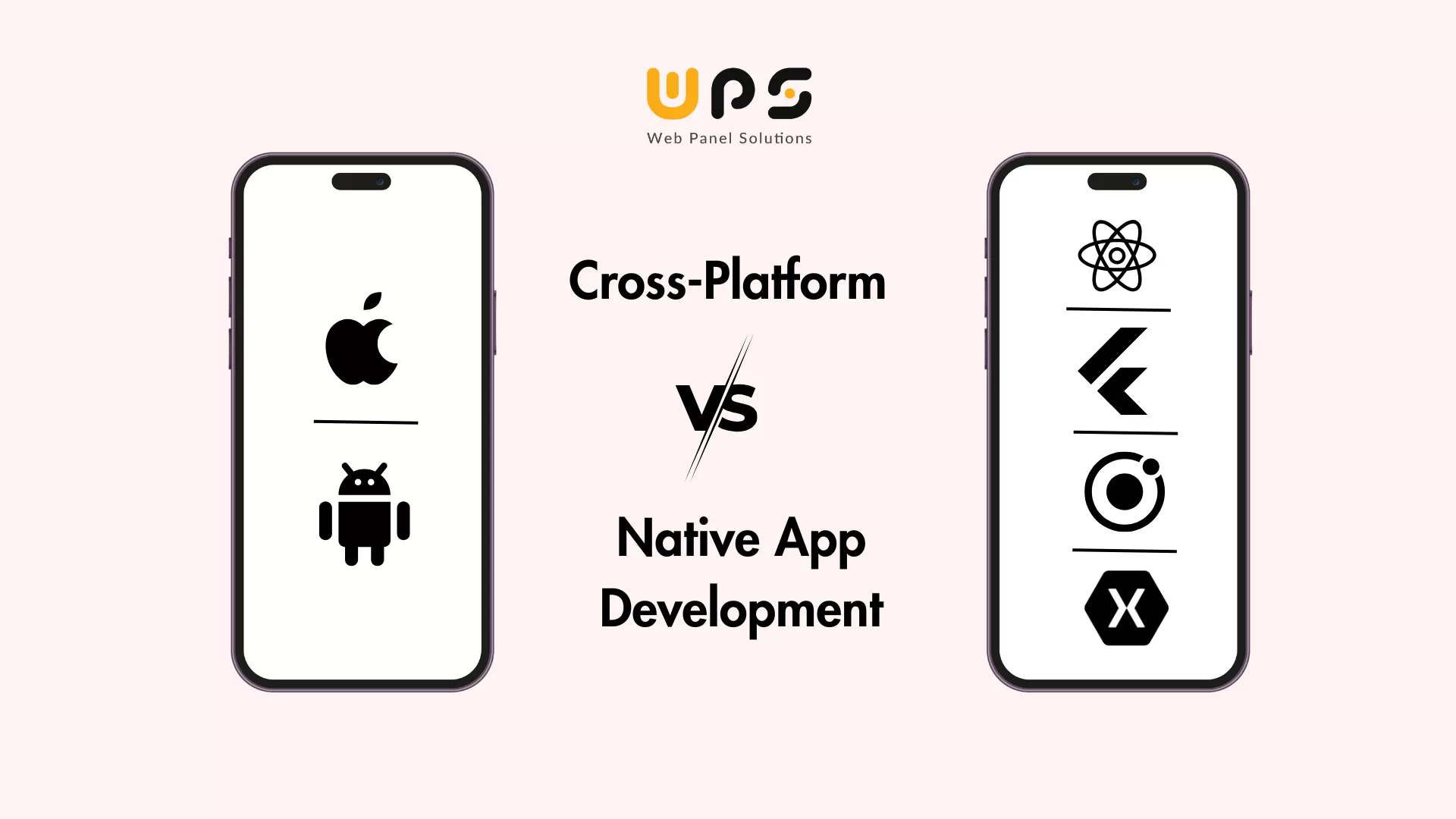
In cross-platform development you get to write code once and make the deployment on several target platforms (like iOS and Android, maybe on the web as well). Common frameworks are:
React Native
Flutter
Xamarin
Ionic
All these frameworks employ a shared codebase written in JavaScript, Dart, or C# and is compiled either into native code at runtime or by using a bridge.
Advantages of Cross-Platform Development
Faster Time-to-Market: Shared code for both platforms speeds up development.
Cost-Efficient: A single development team can deal with both platforms.
Code Reusability: Ability to reuse up to 90% of the code.
Wider Reach: Single app for several platforms.
Disadvantages of Cross-Platform Development
Performance Trade-offs: Additional layers (bridges) between code and platform yield performance loss.
Limited Native Features: Some classes of hardware integrations may be smoother.
UI/UX Compromises: Already tough to nail the native look on each platform.
Dependency on Third-Party Plugins: Compatibility or support might be questionable
Security and Compliance Considerations for Choosing Native App Development, and Cross-Platform App Development
When making a mobile app-development choice and especially when sensitive data such as user credentials, financial transaction data, or patient records are involved, security and compliance assume vital importance.
The development paradigm decided for the mobile app is a determining factor for how well the application stands up to industry standards and protects user data.
Security, in the advanced kind, stands to favor native app development. With developers working directly with APIs specific to the OS, integrating biometric authentication tools (Face ID, Touch ID), keychain security, and hardware-level encryption becomes relatively straightforward.
Moreover, native apps also enjoy the luxuries of faster receipt of new OS-level security comforts as soon as Apple and Google release them. This timely update serves very important purposes in the realms of data protection and compliance.
The cross-platform frameworks, though, have matured in the past few years with many offering plugins or modules for basic security measures such as SSL pinning, secure storage, and encrypted communication; yet, very often, they may fall behind when it comes to supporting new security updates because of their inherent third-party library dependency or delayed updates to the framework itself.
When Should You Choose Native App Development?
When performance matters, as in games or AR apps.
To build a highly complex application with heavy animation work.
When the app involves deep integration with hardware (for example, GPS, camera, sensors).
To provide a platform-specific experience (e.g., Apple Pay or Android-specific features).
Keeping scalability in mind, the app is designed to be built.
Native-first approach applications commonly are:
Instagram (some parts are native)
Spotify
WhatsApp
When Should You Choose Cross-Platform Development?
Go for cross-platform development if:
If an MVP needs to be launched fast.
Both iOS and Android need to be targeted on a limited budget.
The app is relatively simple in terms of functionality or content-based.
To test the product-market fit before investing in native builds.
Your team is proficient with either JavaScript or Dart.
Apps built using cross-platform frameworks include:
Facebook (React Native)
Alibaba (Flutter)
Skype (Xamarin)
Framework Spotlight: React Native Versus Flutter
Two of the best-selling cross-platform frameworks with complementary advantages are React Native and Flutter:
React Native
Originally developed by Facebook.
Uses JavaScript.
Large support from the community and third-party libraries.
Native-like performance through bridges.
Flutter
Originally by Google.
Uses the Dart language.
It renders UIs through its engine and not through any native components.
Better for custom UIs and animations.
React Native is better if: you want wide community support and are familiar with JavaScript. Flutter is better if: you want pixel-perfect UIs with slick rendering.
Try Future-Proofing Your App
Choosing between native or cross-platform largely depends on your long-term vision:
Are there any plans to add platform-specific features in the future?
Will the app turn into a full-fledged ecosystem (smart-watch or smart-TV app)?
Are you thinking about PWA or desktop versions?
If the app were to really take off or go very far down hardware integration, it might be good in the long run to start native. But if you are trying out a new idea or want to go fast, cross-platform could be a better choice for you.
Best Tip- A Hybrid Solution Might Be Best
Some companies go for a hybrid solution, attempting to combine the two approaches to suit their requirements:
Build core features using cross-platform frameworks.
Build specific modules (such as payment gateways, AR experience) natively.
This enables teams to take advantage of the speed and cost efficiencies of cross platform for less critical parts, while optimizing the more critical ones natively.
Web Panel Solutions- The Best Mobile App Development Company
A mobile app is not just the extension of your business — a mobile app is a revolution for your business. We are Web Panel Solutions, an iOS, Android, and cross-platform mobile app development company that designs high-performing apps to boost your brand and improve user engagement.
The secret of our success lies in the combination of expert developers who can make innovation, functionality, and an excellent UI/UX in every project, creating a custom native app or hybrid solution.
We help businesses unlock new opportunities with scalable, secure, AI-powered apps for startups and enterprises. Our end-to-end development process, from ideation to design to deployment and support, felt smooth.
Though Web Panel Solutions isn't alone in making mobile the fastest way to build a product, we’re the leader in transforming your app from just another product to a powerful digital experience that delivers results for your users.
Mobile App Development Services Across All Platforms
Android App Development
We at Web Panel Solutions are a custom android app development services company, which means we develop custom Android apps according to your business needs. Kotlin, Java, and Android Studio are the main languages that our expert developers use in building secure, scalable, and high-performance apps with an excellent user experience across all Android devices.
iOS App Development
Web Panel Solutions is an iOS application development company that creates high-quality, beautiful, yet functional apps. Our team of expert developers specializes in Swift, Objective-C, and Xcode, and your app will be fast, secure, and optimized for all Apple devices, including iPhones, iPads, and Apple Watch.
Web App Development
At Web Panel Solutions, we develop fast, secure, and scalable web applications according to your business needs. Our in-house expert developers are focused on trending and modern frameworks such as React, Angular, Vue.js, and Node.js to give readers flawless performance on any device.
IoT App Development
Web Panel Solutions team are experts in IoT app development and create smart and connected solutions that are transforming businesses. IoT applications developed by our expert developers are safe, scalable, and real-time integrations of smart devices, sensors, and cloud platforms.
Conclusion: What’s Right for You?
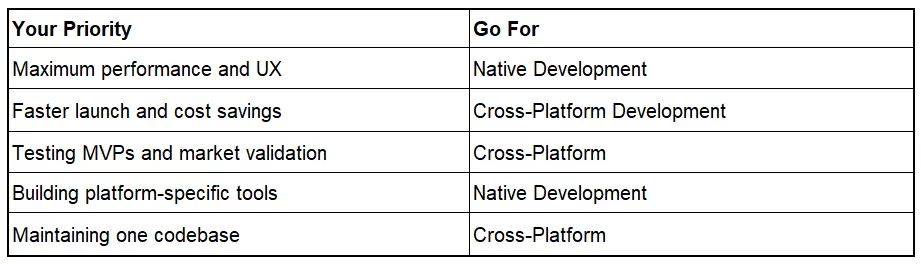
Deciding between cross-platform and native app development depends on the goal of your project, its budget, and its timeline, and complexity and values of the target audience.
Before you decide, do a technical audit, try to analyze user requirements, and ask developers with some experience. Sometimes a hybrid way might mature the best of the two.
We recommend you to consider your project's specific requirements, budget, timeline, target audience, and the importance of performance and native features. After that, weigh the pros and cons of each approach in the context of your unique needs.
Yes, it's technically possible, but it involves rewriting the app using native technologies. This can be a significant undertaking in terms of time and cost. It's usually better to decide on the development approach early in the project.