Having a strong online presence is not only important but also necessary in today's digitally competitive world. Full stack development services provide the depth and required to create dynamic, scalable applications, any way of whether you're an established company redesigning your platform or a startup creating your (Main Valuable Player) MVP. But choosing a full stack development partner is a serious matter.
Both front-end (client-side) and back-end (server-side) development are handled by full stack developers, who provide all-inclusive services that improve workflows and close communication gaps. But how do you pick the best provider if there are so many to choose from?
What is Full Stack Development?
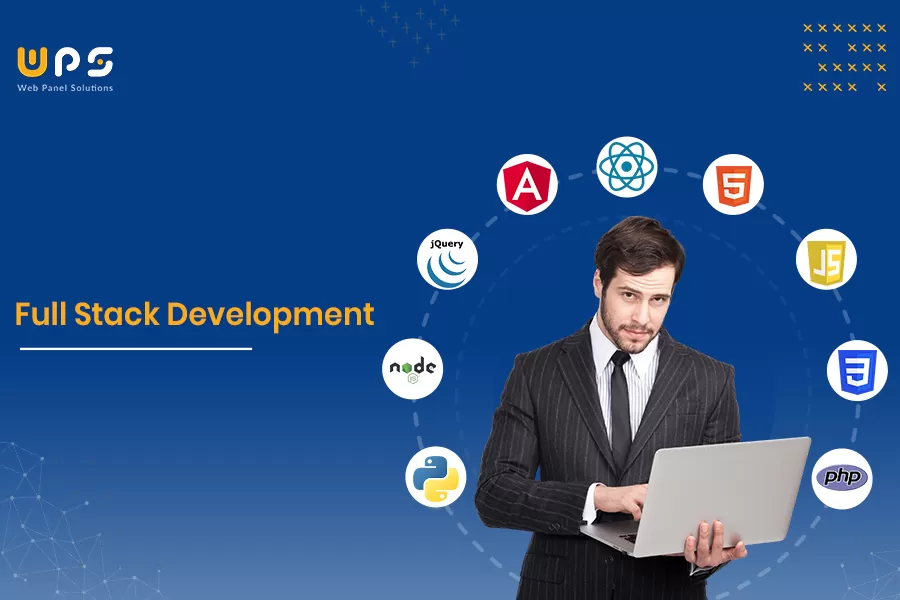
Full-stack development develops an online application on both the client side and the server side. While a full-stack developer works in both these areas, they are familiar with a number of programming languages and frameworks, which gives them the ability to design and implement a complete web application. You can hire front-end developers for your next project from Web Panel Solutions.
Front End Development
The front end is best described as everything. The user has a direct interface within the web page. It includes:
- HTML (HyperText Markup Language): The web page's organization.
- CSS (Cascading Style Sheets): Specific features and structure of web located pages.
- JavaScript: The dynamic characteristics that describe a web page and its interaction with the other web pages.
Some of the commonly used front-end frameworks are React, Angular, and Vue. js.
Back End Development
The back end comprises the server, database, and application details about the server and database. It includes:
- Server-side languages: Node.js, Python, Ruby, PHP.
- Databases: MongoDB, MySQL, PostgreSQL.
- Server management: Handling server operations, APIs, and business logic.
JavaScript, Django, and Ruby on Rails are among the most popular options for backend work.
Benefits of Full Stack Development
When you say, what is full stack development, here are the simplest answers. Combining both front-end and backend skills, a full-stack developer handle:
- UI/UX design
- API development
- Database management
- Server configuration
- Security Protocols
Now, let’s talk about its benefits.
Versatility and Flexibility
Due to the nature of their operations, full-stack developers can work interchangeably on both the front and back ends, making them highly flexible. This makes the development cycle faster and product development more streamlined.
Cost-Effective
A full-stack developer might be more affordable than hiring front-end and back-end developers separately. Having one developer manage the entire stack is beneficial because it cuts down communication overheads and enhances the development process.
Comprehensive Problem Solving
Full-stack developers acquire broad knowledge about everything, which helps them fix issues quickly. Due to their generalist approach, they are able to diagnose problems at any level of the OSI model.
Enhanced Collaboration
Due to their versatility in handling front-end and back-end projects, full-stack developers can act as linkers between teams on these two ends. This integrated approach to treatment thus enhances the final results and makes them more coherent.
Better Maintenance and Updates
If a single developer or a full-stack development team is available, managing and updating the company's application is easy. This way, changes can be made and executed at every layer without the involvement of other teams and departments.
Choose Best Full Stack Development Services With These Tips
We’re living in a digital world, so for an organization to remain relevant, they require strong, adaptable, and performing applications. Full stack development comes as a rescue in such a scenario. It is interesting to think of a web application where one person, a developer, is enough to implement them, down to the UI and the server-side logic.
Fascinating, isn't it? Full-stack developers are one person in web development having many important skills, making them a perfect addition to every tech staff team. Whether you are a new business launching a new product or an organization needing to advance your online presence, full-stack development can be very useful.
1. Technical Expertise and Stack Proficiency:
Assessing technical proficiency is deciding when choosing full stack development services. Both front-end and back-end technologies must be mastered by a capable full stack developer.
Skill in HTML, CSS, and JavaScript frameworks such as React.js, Angular, or Vue.js guarantees dynamic, responsive user interfaces on the front end. For managing data processing, APIs, and business logic on the back-end, expertise with Node.js, Django, Laravel, or Ruby on Rails is important.
Effective data management and storage also require a solid understanding of database systems, both relational (MySQL, PostgreSQL) and non-relational (MongoDB, Firebase). Continuous integration and seamless deployment are supported by knowledge of DevOps tools such as Docker, Git, and CI/CD pipelines. Planning for scalable infrastructure is also made possible by having a solid understanding of cloud services like AWS, Azure, or Google Cloud.
2. Experience and Portfolio
Two important markers of a trustworthy full stack development company is experience and a solid portfolio. A team with years of practical experience contributes a proven development process, deep technical insight, and problem-solving skills.
Their knowledge of various sectors, including eCommerce, healthcare, education, and finance, enables them to understand particular business requirements and provide customized solutions.
You can evaluate the caliber, intricacy, and variety of their prior work by looking through their portfolio. Look for examples of the dashboards, enterprise platforms, web apps, or mobile apps they have created.
3. Project Understanding and Consultation Approach
Understanding your project's objectives, target market, and business challenges in-depth is the first step in receiving a respected full stack development service. The team should actively listen, clarify your vision, and pose intelligent questions during the first consultation.
To formulate the development strategy, a skilled team will frequently carry out feasibility studies, user research, and competitor analysis. Based on industry best practices, they might also recommend changes or different strategies.
At this point, their structured approach is shown by requirement analysis, wireframes, and clear documentation. A team is more likely to provide a solution that satisfies expectations and advance long-term growth if they take the time to fully understand your needs up front.
4. Team Structure and Availability:
Project managers, front-end and back-end developers, UI/UX designers, QA testers, and DevOps engineers are essential positions for a professional service provider. To guarantee on-time delivery, high-quality code, and a perfect user experience, every team member is essential.
Availability is just as trying. For seamless collaboration, the team should offer flexible working hours or be in sync with your time zone. Seek out suppliers who provide regular updates, scheduled meetings, and consistent communication via designated channels.
Delays and misunderstandings can be prevented with a clear growth path and a point of contact (POC). A team that is ready and responsive advances trust and speeds up development.
5. UI/UX Skills:
To make apps that are not only useful but also easy to use and fun to use, you need to have strong UI/UX skills. A good full stack development team should have UI/UX designers who know how to design for users. They should know how to use Figma, Adobe XD, or Sketch to make wireframes, mock-ups, and interactive prototypes.
Good UI/UX design makes sure that navigation is smooth, that the site works on all devices, and that the visuals are consistent. The team should also put accessibility first and do usability testing to find and fix problems early.
Also, they should be able to use feedback from users to make design changes that are better each time. UI/UX is an important part of successful full stack development because a well-designed interface makes users happier, lowers bounce rates, and boosts conversions.
6. Security Standards and Compliance:
Security is an important part of full stack development, especially when dealing with private user information or money. A trustworthy development team should use strong security measures like HTTPS protocols, SSL encryption, secure authentication, and regular exposure assessments.
They also need to protect against common threats like cross-site scripting (XSS), SQL injection, and cross-site request forgery (CSRF). Also, it is important to follow industry keeping standards like GDPR for data privacy, HIPAA for healthcare, and PCI-DSS for payment security.
A professional team at a full stack development company will use secure coding methods, set up role-based access control (RBAC), and keep security patches up to date. Putting security first from the start helps keep your application in line with the law and protect user trust.
7. Support and Maintenance After Launch:
After maintenance and post-launch support are very important to keep your application safe, working, and up to date. A good full stack development service should offer ongoing support that includes fixing bugs, improving performance, updating software, and making sure it works with new devices or browsers.
Find out if they offer free support after the launch and what services are included. For long-term maintenance, reliable teams also offer service level agreements (SLAs) that guarantee quick response times and problem solving.
Your app can grow with user needs and market trends if you regularly update it, patch security holes, and add new features. Choosing a provider with good support after launch will keep your digital product running longer, keep users happy, and reduce downtime.
8. Project Management and Communication Tools
Successful full stack development depends on efficient project management and effective communication. Throughout the course of a project, a professional team should use industry-standard tools to guarantee openness, cooperation, and timely updates.
Real-time conversations and video conferences are made possible by communication tools such as Zoom, Microsoft Teams, and Slack. Platforms like Jira, Trello, Asana, or Click Up facilitate the management of tasks, due dates, and progress reports for project tracking.
Code sharing and cooperative development with appropriate documentation are made possible by version control systems such as GitHub or GitLab. Regular stand-ups, milestone reviews, and a well-defined project workflow guarantee that the project stays on course.
Project management and well-structured communication reduce miscommunication, speed up delivery, and promote a positive client-developer relationship.
9. Budget Transparency and Pricing Models
Make sure the full stack development service provider lists all expenses, such as development, testing, third-party tools, hosting, and post-launch support, before you sign a contract. Watch out for estimates and hidden fees. A reliable group will offer thorough proposals, schedules, and deliverables linked to particular benchmarks.
In addition to forward trust, transparent pricing enables wise investment planning. Additionally, it guarantees that the development stays within your material control without sacrificing quality and helps prevent cost over-runs.
Conclusion
Choosing the right full stack development services involves more than just judging technical capabilities. It’s about finding a long-term partner who understands your business vision, offers end-to-end solutions, prioritizes security and scalability, and maintains transparent communication.
By carefully assessing the factors mentioned above, you can minimize risks, optimize resources, and ensure a successful digital transformation for your business. Whether it’s a web application, mobile app, or enterprise platform, the right full stack team will help turn your idea into a high-performing product.