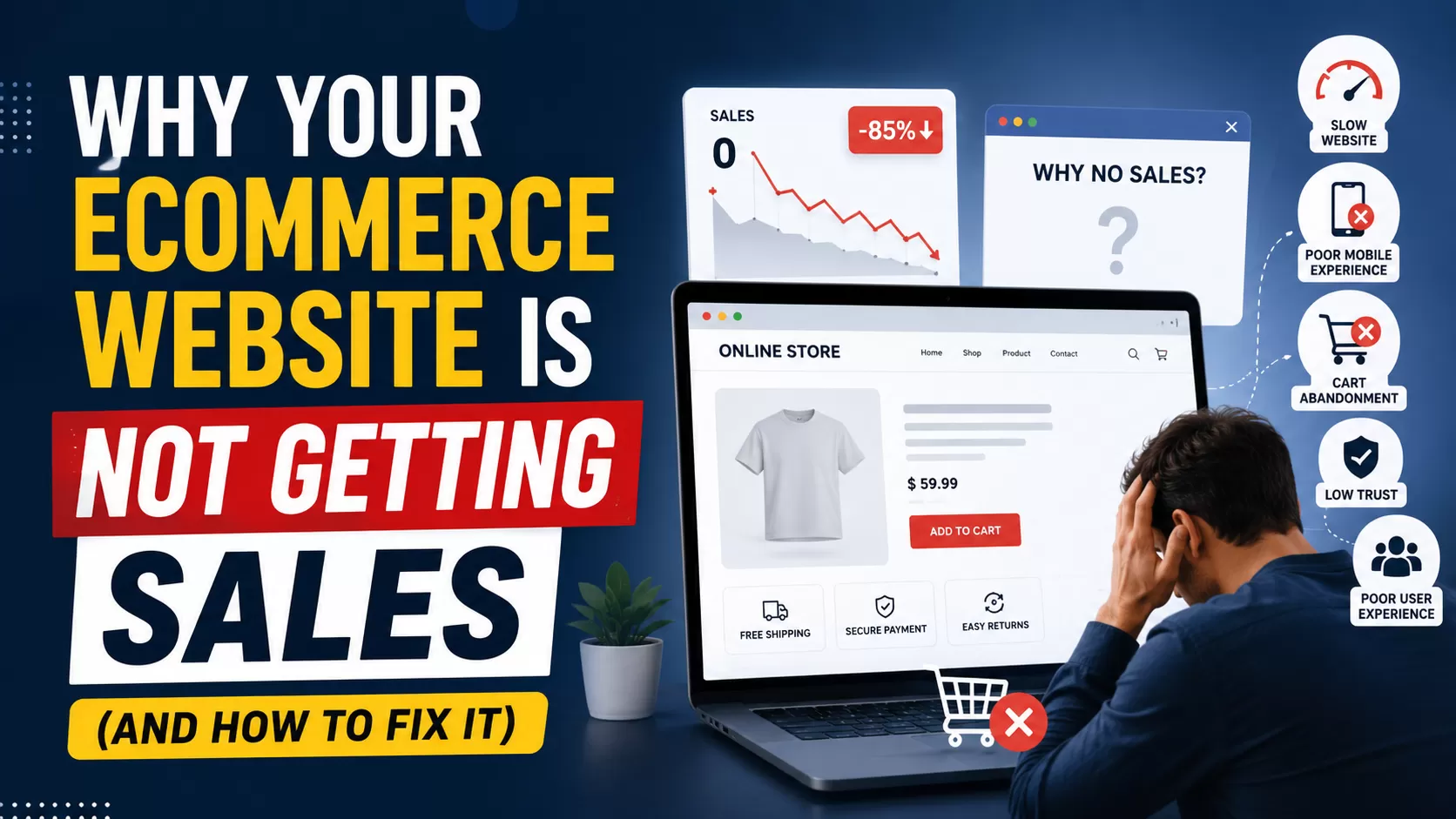
You launched your ecommerce website with big expectations.
The products are good, the ads are running, and traffic is coming in - but sales are still disappointing.
This is one of the most common problems ecommerce businesses face today.
Many business owners think the issue is their pricing or products, but in reality, the problem often lies in the website experience itself.
A slow, outdated, or poorly optimized ecommerce website can silently push customers away before they even reach checkout.
In this article, we’ll explain the real reasons why your ecommerce website may not be generating sales and what you can do to fix it.
1. Your Website Loads Too Slowly
Online shoppers are impatient. If your website takes too long to load, most visitors will leave within seconds.
Many ecommerce businesses spend thousands on marketing, only to lose customers because their website performance is poor.
A slow website can:
- Increase bounce rates
- Reduce trust
- Lower conversions
- Affect Google rankings
Even a few seconds of delay can impact your revenue.
How to Fix It
- Compress heavy images
- Use reliable hosting
- Remove unnecessary plugins
- Optimize website code and scripts
A faster ecommerce website creates a better user experience and improves the chances of getting sales.
2. Your Mobile Experience Is Weak
Today, most ecommerce traffic comes from mobile users. If your website is difficult to use on a smartphone, customers won’t stay for long.
Common mobile issues include:
- Small buttons
- Broken layouts
- Slow loading
- Difficult navigation
Many businesses focus only on desktop design and completely ignore mobile optimization.
That’s a costly mistake.
How to Fix It
Your ecommerce website should be:
- Mobile responsive
- Fast on all devices
- Easy to navigate
- Optimized for touch interaction
A smooth mobile experience directly affects conversions.
3. Your Website Looks Untrustworthy
First impressions matter more than ever in ecommerce.
If your website looks outdated, cluttered, or unprofessional, visitors may hesitate to buy - even if your products are excellent.
Customers often judge a business within seconds based on:
- Website design
- Product presentation
- Navigation quality
- Brand consistency
A poor design creates doubt.
How to Fix It
- Use clean and modern layouts
- Maintain consistent branding
- Use high-quality visuals
- Keep navigation simple
Good design is not just about appearance - it builds trust and confidence.
4. Your Checkout Process Is Complicated
One of the biggest reasons ecommerce websites lose sales is cart abandonment.
Customers may add products to the cart but leave before completing payment because the checkout process feels frustrating.
Common problems:
- Too many form fields
- Forced account creation
- Limited payment methods
- Unexpected charges
How to Fix It
- Simplify checkout steps
- Enable guest checkout
- Offer multiple payment options
- Show transparent pricing
A smooth checkout experience can significantly improve conversion rates.
5. Your Product Pages Are Not Convincing
Product pages are where buying decisions happen.
If your pages lack proper information, customers may leave without purchasing.
Weak product pages usually contain:
- Poor-quality images
- Generic descriptions
- No reviews
- Missing product details
How to Fix It
Create product pages with:
- High-resolution images
- Detailed descriptions
- Customer testimonials
- Clear pricing and benefits
Good product pages answer customer questions before they ask them.
Also read: How Much Does It Cost to Build an eCommerce Website?
6. Your Website Lacks Trust Signals
Trust is one of the most important factors in ecommerce.
If customers don’t feel safe, they won’t buy.
Many ecommerce websites fail because they don’t include basic trust elements.
Important trust signals include:
- SSL certificate (HTTPS)
- Secure payment icons
- Customer reviews
- Contact information
- Return and refund policies
How to Fix It
- Display trust-building elements clearly across your website.
- The more secure and transparent your website feels, the higher your conversion chances become.
7. Your Call-to-Action Is Weak
Sometimes visitors simply don’t know what action to take.
If your buttons or messaging are unclear, users may leave without converting.
Weak CTAs create confusion.
Examples of Better CTAs
- Buy Now
- Shop Now
- Get Started
- Add to Cart
How to Fix It
Use clear, bold, and visible CTA buttons throughout your ecommerce website.
Guide users toward the next step instead of making them guess.
8. Your Ecommerce Website Is Not SEO Optimized
Even a beautiful ecommerce website cannot generate sales if people cannot find it online.
Without proper SEO:
- Your traffic stays low
- Visibility decreases
- Competitors dominate search results
How to Fix It
Optimize your ecommerce website for:
- Relevant keywords
- Mobile performance
- Page speed
- Product page SEO
- Internal linking
SEO helps attract customers who are already searching for your products.
Signs Your Ecommerce Website Needs Improvement
If your website has these problems, it may be affecting your sales:
- High bounce rate
- Low conversion rate
- Cart abandonment
- Poor mobile experience
- Low search visibility
Ignoring these issues can slow down your business growth.
Must Read: Ecommerce Website Development Guide
How to Increase Ecommerce Website Sales
Improving ecommerce sales is not about making random changes. It requires a proper strategy.
Focus on:
- Better user experience
- Faster performance
- Mobile optimization
- Conversion-focused design
- Simplified checkout
- SEO improvements
Small improvements in user experience can create a major impact on sales.
Final Thoughts
A successful ecommerce website should do more than just look attractive.
It should:
- Build trust
- Improve customer experience
- Guide users toward purchase
- Increase conversions consistently
If your ecommerce website is not generating sales, the problem may not be your products - it may be the experience your website provides.
Fixing these issues can help turn visitors into paying customers and improve your long-term business growth.
Looking to Build a High-Converting Ecommerce Website?
If you want a fast, modern, and conversion-focused ecommerce website designed to grow your business, our team can help you create a solution tailored to your goals.
Frequently Asked Questions
Your ecommerce website may not be getting sales because of slow loading speed, poor website design, weak mobile experience, complicated checkout, or lack of trust signals.
Yes, a slow ecommerce website can increase bounce rates and reduce conversions. Faster websites provide a better user experience and improve customer retention.
You can improve conversions by optimizing website speed, simplifying checkout, improving product pages, using better CTAs, and creating a mobile-friendly design.
Most online shoppers use mobile devices. A mobile-friendly ecommerce website improves user experience, increases engagement, and helps generate more sales.
Common mistakes include poor website design, slow loading speed, complicated checkout process, weak SEO, low-quality product pages, and lack of customer trust signals.